Transcript
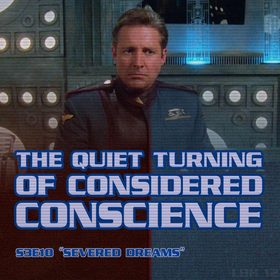
#12 – The Quiet Turning of Considered Conscience (SEVERED DREAMS)
JOSH In some ways, this whole podcast has been leading up to covering this episode. Back in the halcyon 1990s, a syndicated sci fi TV series warned us that it indeed can happen here.
JOHN In this podcast, we use Babylon 5 to talk through our current political moment and attempt to process, understand, and perhaps find hope.
JOSH So, yeah, we're obviously talking about Severed Dreams. And did you know this is the highest rated episode of Babylon 5 on IMDb?
JOHN I believe it and I know it won the, I think it won the Hugo and it always stood out to me. So it's no, no surprise that this is the highest rated episode. It's just, it's also just an enjoyable episode to revisit overall. I mean, it's just, it works so well on every single level. And you go back and you say, wow, they really pulled this one off. Whether it was a combination of the writing, the directing, the acting, everything, just like, yep, no, this was it. I wonder if J. Maas was sort of writing a lot of the series, waiting for this moment to come, because it really feels like this was so well crafted that they knew what they were doing with this. It wasn't like, hey, let's see if this works. It was, nope. This is what we've been building. This is what we want to be able to show you.
JOSH Like you Severed Dreams is the episode of this show that for me, everything that this show does well, it does well in this episode.
JOHN Yeah.
JOSH And it is also the example of how this show was approaching sequence serialized, multi year storytelling on television in a way that no show had the idea that you would change the premise of the show in such a foundational way. Especially given that the only model that we had for a show like this was Star Trek. And Star Trek would never have the Federation suddenly the bad guys, certainly not for the rest of the series. I mean, you may have an episode where, you know, parasitic aliens have infiltrated Starfleet and all of a sudden we have to go up against. But that's only situational. It's not. Here is the premise of the show. So yeah, this episode, watching it at 12 years old was like the most incredible thing I'd ever seen. It really was. And I wore the tape out. I watched this episode so many times. Like just the sheer audacity of the show to do this. And it didn't seem out of left field. The groundwork was laid since the very first episode of the show. Like, as we have discussed, exceeding these little developments and hints of things, mentions of something on a news report in the background in an unrelated episode. And then obviously we've already covered the two episodes prior to this, but this is the conclusion of a trilogy of episodes really all leading to this moment of inevitability.
JOHN I want to talk later on about
JOSH the inevitability component of really resonates with me in the real world situation that we find ourselves. The sort of point of no return, as it were, in this episode is the illegal bombing of civilians on Mars when they refus to implement the martial law decree. And you know, Major Ryan is like, hopefully more people will side with them and they can force Clark out. So like, even at this late moment where he knows Clark has spent years filling the government with his people and he's already disbanded the Senate, all of this stuff has happened already and they're still hoping against hope that common sense and rationality will prevail and order will reassert itself. And that's something I relate to very much now because even seeing what is going on in the world and in our country, there's still a part of me that is hoping, or not even hoping, but sort of expecting common sense and decency to reassert itself in this show. Doesn't happen.
JOHN Well, but as you said, but the characters are thinking the same as we are. And I think that's the brilliance of how he takes real history, real human nature, puts it against the sci fi backdrop to really explore interesting stories that are applicable and relevant, but they're just otherworldly enough that you don't feel like you're being talked to by a teacher. And we all hope for that. I mean, that it makes sense. It's very relatable that Sheridan, Ivanova, they sit there and point a no return there. They're just like, yeah, it's coming here. I mean, they knew it was coming. And even as it starts coming, even as the Alexander is on its way to the station, he said that that's when they still think something else will happen. The breaking point is the Mars attack by the Clark administration. That's, that's the point at which, you know, you sort of assume, well, there's going to be some conflict, maybe they'll get out of it. You know, we all know that the station couldn't, you know, just unilaterally declare independence. It wouldn't have quite made story sense yet. But that action was the final action, not the presence of the Alexander. They spend a good chunk of the beginning of that episode of like, hey, he's tongue his own crew. The Alexander's coming. We don't like what's going on. We're basically going to render humanitarian aid. And then, you know, is that itself a disobeying order? Absolutely. I mean, there are standing orders to hunt down the Alexander. So for the station not to carry those out is a violation of orders, even though he is, in theory, upholding the actual law of rendering aid and everything else. It's that strange middle zone that every military finds itself in. There are laws in the books, there are rules and regulations, and then there's what the commander in chief says. This is applicable because in our world, we'll tie it right in. They're the six senators who very recently. But, you know, most prominently Senator Mark Kelly from Arizona, you know, putting an ad on TV trying to remind both Americans and service members that they have a duty to not follow an illegal order. And that prompted such a response from the administration. Accusations of treason, literal investigations from the Department of Justice, the instigation of a process to demote after retirement the ranks of those who had been service members. A wild response, all to what is, from the outside, a very clear First Amendment protected statement of, hey, we are asking you to follow the laws and the Constitution of this country very specifically in that even when an order comes down from the commander in chief, if it is against the law, you are not supposed to follow it and you're supposed to stand up for that. And that's a very conflicted standpoint because we've discussed that in the episodes where, when Sheridan is freeing Proxima and the other colonies, you know, that the officers themselves are just constantly caught in the middle of this. Well, do we? Don't we? What do we do? All that split in the hair, mighty thin, all those lines that came out about that. But to see an actual reaction, an accusation of treason shows you where we're at, shows that that is the concept, that, no, the. The professional military is not there to follow the law. They're there to follow the commander in chief, if you follow what this administration is saying. And Clark is very much doing the same. And he's relying on the fact that he appointed his own people to accelerate that process. And that's. That's been what's happening today as well. So I see it as absolutely relevant and terrifying because Sheridan is. Is arguably playing it by the book while also being humanitarian and moral. But does that matter to Clark and the other generals who are like, yeah, you just disobeyed an order? No. That's what strikes me about the administration today. There is lip service paid to the idea of a constitution, the established law of the land. But what the repeated statements over time get to is that it's about absolute power in the executive or absolute power in the person who has been elected or otherwise, you know, is in that office. And the president's not alone in that and certainly not in history and not even necessarily in this country that we've never had anybody outright try to exert that power and claim their right to do so as if they were a monarch, as if they were unchallenged. You see it in dictators across the world, many of whom were elected through a democratic process. In fact, that's a fairly common 20th and 21st century motive, is that a democratic. Democratic process elects somebody. And they say, well, you elected me, now I have all the power. This show is saying, well, we have. There's a democratic process. There was President Santiago. There was a succession after he's, as we know on the show, is assassinated by President Clark's people. We know that, you know, that was the background case. But to the rest, it was just. Well, it was a tragic illness and death. It was the illness of President Clark that kept off the ship. And the ship, you know, had an unfortunate accident. So to the people, everything seems above board. The legal process has even followed. Clark is not concerned with that insofar as he's just using the tools he has to amass more power. And I feel like that's a substantial parallel today. Where's Congress in its pushback? Where are the courts? They are pushing back to some degree, but you have a number of appointees who are twisting themselves in knots and ruling after ruling to ensure that this president can do whatever they want. And then the shocking ruling of last year granting a president unchallenged immunity for any action taken as an official act, which is mind boggling, because when we jump to Wilpost Severed Dreams when they deal with President Clark even though he takes his own life, the language they use is we are arresting President Clark for violating X, Y and Z. The scary part about it, we don't know. Jameis didn't give us the entire legal structure of the Earth alliance constitution and government. But if you go with this recent court ruling, there is nothing that a US President could do, nothing that is in any way a violation of the law, except if the high threshold of impeachment is reached. So only ever if impeachment and the court ruling did seem to indicate that would also have to be during their term. So martial law is declared, as is in this show. You know, Saying, well, we can't even let you assemble right now. It's due to an emergency. There's no physical way for an impeachment proceeding to happen within, let's say, the time limit of a term or while that person is in power. So in our world, it looks like there is effectively no mechanism for accountability outside the extraordinary possibility of 67 senators out of a hundred. So whenever you hear that word, martial law and we know going to this episode martial law has been declared. Everybody's, you know, freaking out about that. But then you get Mars. And that's the part of the episode where you go. You know where the episode is. Okay, gonna deal with the Alexander. Oh, this is gonna be some massive to deal with now. Like, it's gonna be a nightmare. They're talking about it. They're preparing for it. Then Mars happens. The camera pulls out on Sheridan in a way. And I think you would know the technical terminology for what that's called. But it wasn't just us pull out. The perspective changed as well as if the focus was being realigned. And Sheridan, for that moment, is, I think, meant to be perceived as alone for just that moment in his own existence of, like, this just happened as if the world went silent all of existence came to a screeching halt. And there he is having to decide what to do next. And then he decides. But when he decides what he thinks should happen he then goes to his crew, the command officers and says something really important. He said, if it was just us, what's that? It pays your money. You take your chances. But it's not just us. It's a quarter million people, an entire Earth alliance relying on us. He instantly takes that massive decision and says, it's not just up to me. I'm not a God. Maybe the military Governor of Babylon 5 but that does not make him the exclusive person in charge of everything that everybody just has to go along with. He asks the crew. They lay it out. They each have their say. And in that moment, they each say, fight. That's something, to me, that again, reminds us as a viewer who Sheridan is what type of person he is, what his moral code is. And, yes, it gives the viewer a sense of, like, well, they are on the moral high ground here and they're doing what they can do now. And that's the moment when Babylon 5 prepares to declare independence. And then. And this is the moment I've been waiting to talk about because it ties back to our previous episodes. Then he sends a message to his family and talks to his father. And everything we had talked about in a previous episode about the strength and beauty of their relationship. This idea of a bond and support and deep understanding of a really wise parent and a son who's growing into an extraordinary person as a result is so beautiful in that scene. And I think we talked about how that was sort of the epitome of healthy masculinity. And there it was on screen, you know, for you to see that he's made the decision, but he wants to talk to his father and he wants to say goodbye, and he sort of wants to, you know, explain, like, things are going to get rough for a while. And I think of the moments in the show that's a standout. As much as this episode has the amazing special effects, the really dramatic moments, the big dramatic moments, the important dramatic moments, this one still stands out as a moment that I'll always think amongst the most important in the show. And the way the father says, they're talking essentially in a code. They're not saying anything obvious over an open channel. The way he talks about, well, your mother's okay, and I love the way he says, I don't even know what she gets up to most of the day, but if she's happy, I'm happy. It struck me as like, oh, that is like the ideal, like, senior citizen couple. They're just, like, embracing their life. He's trying to farm, the corn's all dry. She's often. And it just. It strikes me as this incredibly support, supportive, healthy relationship. And that's when you know where Sheridan gets his strength. You know, that as he does the hardest thing he's ever had to do, that he had that internal wellspring because of how he was raised. And seeing that, it makes so much more sense than just a character who's written on the page. This guy's strong. Like, okay, well, now you've shown us why John Sheridan is so amazing. And then that quiet moment goes right into the rest of the episode where the intensity and the. The battles and the drama really unfold. So, yeah, that's another reason why you can't really beat this episode. For amongst the best in the series. Like, how do you pull all that off in, what is it, 44 minutes? I'm watching the episode and I kept on thinking, okay, well, I've been watching, like, for an hour. Even on my 10th re watch of the show, I'm like, oh, there's more to come. Wait, how could this only be that amount? Somehow that all worked. But, yes, seeing this in its relevance today, it's not an easy. Not an easy thing.
JOSH No, not at all an easy thing. And, you know, one is tempted to look at the Mars inflection point and try to map it on to what's happening in our real world. And I keep thinking of, you know, Minnesota and the murder of Renee Good and Alex Preddy. I believe their names are among others. You know, they aren't the only ones who have died at the hands of ice but those two stand out for the. The documentation and the like, clear egregiousness of how it happened. And, yeah, you know, there's something about this episode because of who Sheridan is because of his role within the proverbial system and his status as a military governor of this outpost. He's in a position where he can do something about it. You know, taking a stand, declaring Babylon 5's independence. That changes the dynamics of the situation in a substantive way. It strikes me, you know, we've been saying on this show, you know, when are we going to have our severed dreams moment? And we hope it never comes. I think the idea was, you know, we would sort of hold off on watching this episode until we reached a clear proximal moment that that was analogous to what happened in the show. You know, not that we were looking forward to that happening, but that was sort of the thinking. And I don't know that it's going to play out for us that decisively.
JOHN That's a good word for it.
JOSH You know, in this episode, it was clear President Clark gave an order to murder civilians.
JOHN Right? Yeah.
JOSH And once Sheridan heard that, he was like, well, whatever reservations I had before, this is a clear line he has crossed that cannot go without a response. You know, seeing that video of Renee Goode shot and the circumstances surrounding it, you know, I don't see how you could see that and not see it as a clear, you know, line of, well, okay, if this is what the state is willing to do, then, you know, what is a justified, appropriate response. But it's hard because, once again, it's not like the governor of Minnesota is about to secede from the Union. Right.
JOHN Right.
JOSH And it's not like, you know, there's some fuzziness there in terms of the accountability. I mean, obviously the buck is supposed to stop with the president. And in any normal administration, someone would have resigned already. Probably multiple someones would have resigned already and there would be investigations and there would be hell to pay. This administration is allergic to the concept of accountability. The line seems to be, well, you know, she deserved it. Or like, what do you expect?
JOHN Yeah, something you just are alerted to accountability. And that's deliberate. That is the Roy Cohn school of thought, that is that Trump was tutored under Roy Cohn, being the assistant to McCarthy back in the 50s.
JOSH Isn't that so wild that you can draw a straight line from what's happening now to the previous sort of like ur example of, you know, authoritarianism in the American government? It's just wild that there's a direction line from 1950s McCarthy to 2020's Donald Trump. It's crazy.
JOHN Not even, not even a metaphorical or comparative line. It is these same people. And something to quickly divert on before I want to try to remember, to get back what you said with as that line, the appropriate word is actually fascist, though it is thrown around a lot today and in many cases accurately in the current climate. But something really important to highlight about that word is, is that it is a form of authoritarianism centered around a almost mythological national identity. It's. That's a very important component of it. And you see that profoundly in McCarthyism. You know, the very notion of being un American. And you certainly saw that in the Second World War with the Germans. That was the core of it. And that is the basis of what is communicated right now. That's why ICE is at the center of this, because it is carrying out this idea of weeding out those who are not part of this pure mythical version of the United States. So it makes a sort of sense that this constantly reemerges, that very often the same people get quiet for a while and they or their descendants or their heirs come back roaring because it's such a profound instinct. And for Trump to have been trained by this man, raised as a surrogate father almost, with the core idea being that if you want to win, if you want to exert power, whether it's. In this case, it was winning at politics, winning at business. And initially it was business, now translated into politics. It was never apologize, never admit fault. You may yourself have to correct course to get what you want out of something, but never ever admit fault. We grew up in an era up until just a recent decade that virtually every politician, no matter how far they pushed it, would ultimately, if they really got caught with their hand in the cookie jar, would at least give a perfunctory mea culpa. You know, they'd say something. And that was part of the core culture. And by and large it was. It was a culture of resignation, which, which if you look at the number of people who've resigned in the last 45 years for what are today very minor offenses. I mean, it's sort of wild to compare it to. You think of how people were either knocked out of election races, whether it was for an extramarital affair or a weird yell on TV of enthusiasm, like the things that could literally knock you out of political contention or force a resignation of a cabinet member. And that things orders of magnitude worse than that. Don't even prompt. Well, that's the strategy. Do not apologize. Do something horrific, don't apologize for it. And then the other humans listening to you will say, well, it's kind of weird. If they didn't apologize, did they really do anything wrong? And the cognitive dissonance starts up. And one could say from their perspective, well, Trump has never done anything wrong, but he's never even shown. He would have at least shown that he did something wrong once. No, he. No, he's. He's just a victim of people going after him. That's the story that gets promoted. And I understand that better than ever now. So without that, without something of somebody saying, this is enough and you're accountable for that, it's really hard to push back. And now translate that to the. Those who work in the administration and those who serve as the foot soldiers in it. If they're getting from the top that we never admit to a mistake by default, they could never hold their own accountable, even if it is by law. So the very idea of holding the. What is to anyone's eyes, the capital execution of Alex Peretti, it would completely undermine the core operational principle of the administration, which is to never admit fault. Today there's more news on that. Another case of a woman who was shot in October by ICE officers. And the claim was, oh, she rammed them. Now, the footage that a judge did force to be released shows not only did she not ram them, they rammed her to get out and fire five shots. She survived and is trying to sue. But the idea of no accountability, if any of these people were held accountable for these actions, it would begin to undermine that so far, perfect armor that has been put around the office today, which is why I think it's so strong. And you do need some pushback. And I think about, you know, how that applies to what happens this episode. Mars. Well, Babylon 5 declares independence. But it's not for another year and a half. Showtime. That Sheridan, due to completely other circumstances, is able to do anything about, you know, freeing Earth. For another year and a half. Earth sinks further, day by day into this authoritarian nightmare. Babylon 5's independence. While a bright moment, the episode is not titled Upright moment. Yay, we've declared independence. It is called Severed Dreams. They are severed from their dreams, are severed from the Earth Alliance. It is a sad title. It's a tragic title. You can get hope from it and that an action has been taken. But it's not meant to be a title like, well, here the good stuff begins now. From here on out, it's like, no, we don't know what to do from here on out.
JOSH The very end of the episode, I think sums that up perfectly because you have Sheridan walking in to the Zocalo and there's this round of applause for the fact that he took a stand and it worked and blah, blah, blah. But the camera pushes into Sheridan, moves past Sheridan and the command staff, and focuses on the propaganda poster on the wall behind them that says traitors can't hide. And it's this sort of like, ominous final note, right? You know, sort of reminding us. It's like, okay, we have our little hard won victory and it's a moment of triumph in this moment, but this is not good. And whatever happens next, there will be a lot of shit to go through between here and there, regardless of the outcome this episode. One of the reasons why it's so, you know, you felt like you've been watching it for an hour and not in a bad way. It's just there's like so much here that is substantive that you feel like, oh, well, I must have been watching this for a long time because there's all this stuff going on, you know. And again, I think the space battle in this episode is one of the all time great space battles in all of sci fi. And I think it has to do with the fact that, you know, you're really invested in the emotional stakes of what's going on, you know, and it's not like, I mean, there is a little rah, rah, pew, pew, pew. This is so cool. It starts out that way, but then it keeps going and it keeps going and it actually goes on for a pretty long time. And all of a sudden it starts to be exhausting.
JOHN You read my mind.
JOSH You know, the shooting between the ship starts and then the Earth Force ships send in the breaching pod. They send troops physically on the station. And it starts out, you know, they're firing their PPGs at each other, and then later on they've run out of ammo and they're just knocking the shit out of each other. And it's brutal. And then at the end of the battle, right after the moment, like the moment of triumph in the whole episode, maybe the whole series, where Delenn shows up and she saves the day. And, like, you're on a high immediately after that, you show the bodies and the pain and the moaning and the suffering and the blood of what happened down there. You know, Jamis says time and time again that Babylon 5 is about choices and consequences and responsibility. And he can't show you the really neat pew, pew stuff without showing you the consequences. And it's very sobering.
JOHN It reminds me that, you know, a couple years later, the movie Saving Private Ryan comes out and you have the beginning 20 minutes or so, which is the D Day invasion of Normandy. And it is, from, as far as cinematography goes, direction, an astonishing achievement. There's nothing enjoyable about it. It's horrifying. It's 20 minutes. He said it grinds you down at exhaust. You have 20 minutes of just watching people get cut down and fighting for their lives. In my sense, this is a television version, you know, fitting into a 44 minute episode as part of it that's trying to show the same thing. It's not the glorification of war. You know, we're not running into it like a bunch of Klingons celebrating, anticipating the blood wine or, you know, going to the afterlife. It's. This is the reality. It's brutal and horrible and you don't want to have to do this. This isn't what should be done. And when it has to be done, we have already passed a point of being so screwed. And you see the fallen Marines and Narn and B5 security officers probably more the blood than we usually seen in the show because they didn't use blood as a special effect or as a realistic effect in the show. Very often. Ppg, seal the wounds, things like that. This was how people were very clearly paralyzed. You know, there's the Marine and she's there and you could tell, like, she can't feel her legs. Is why you don't want to have to do this. This is why Sheridan wasn't frothing at the mouth like, oh, just bring him on. Like, it was like, no, this is the last thing you want to have to do. Because in the real world, war is horrific. And you don't. You don't just do it off of an impulse if you're a decent person. I mean, obviously that's not the case in all of history and the people who make those decisions. And it makes It a little bit. You're right. You don't celebrate the end of this episode as the heroes wrapped up another 44 minutes. You know, solving the episode's dramatic problem. That's not at all what happened. It got us to the next point, you know, and here's what they're talking about. Oh, well, problem, sabotage. We'll have all these other things. It's setting us up for the next few episodes where it's the aftermath. What do we do when we deal with what we just did and the next episode is even deal with, like, the logistics. How does the station survive without a pipeline of supplies coming regularly from Earth? They have to figure all this stuff out. This wasn't a, you know, adolescent, intense decision being made by somebody who just wanted to, like, just be. And that's why the show, I think, is even more satisfying because it's that much more real. And it broadens the story to something that is even more accessible. But it makes you think. And that's not necessarily something. People always want that as something. I want to go back to how the. The moment where you said, you know, barring when Delenn comes. JMS even talked about why that wasn't even mentioned as an option from the beginning. Sheridan doesn't ask Delenn to help defend the station because they very. I put in my notes very specifically telegraphed her exit. So she has stuff to deal with. They deliberately put into the early part. Again, there are two major components of the episode that start off that don't even deal with. This one is a very quick intro, which is not humans. It's the ambassador, Centauri, Ambassador Malari coming back on the station making a snide comment about the Narns. And the Narns using what is best described as malicious compliance to slow his readmission to the station down. Oh, yes, you've. Narns, we are so inefficient. Brilliant moment. And that's when, you know, Londo is saying, ah, these things are falling apart on Earth. Then we get to see that. Then the Ranger coming in and showing that their Shadows have been at work messing around with the. With a League of Non Aligned Worlds pitting everybody against each other doing exactly what the Shadows do. And the Gray Council did not hear or want to hear what the Rangers had to say. So Delenn is in a real bind there. So she has a major thing to deal with here. But she knows what's happening with the station. She knows at that point, though they don't say it directly. But timing wise, you probably know Alexander's on its way but she has to leave to take care of us and they have a goodbye. Her shuttle takes off, goes through the gate and a second later, the jump point forms. And is that. Oh, in my mind, just what. That's. The Alexander comes right through. Right at that point.
JOSH Right.
JOHN Because then the Churchill comes shortly after. And that's, again, you're dealing with 44 minutes. I always say that. Remind people, like, this is a real miracle. You have to deal with everything in that time frame and say everything you want to say. Severy, clearly, in a quick shot, says, she's gone, this next thing starts. But she has her story now to go on. And that's the other part of the episode that's also terribly relevant. Ivanova makes a comment in their meeting, you know, like, hasn't anybody pushed back? Yep. And that's when the major says, listen, Clark has been putting his own people in power for the last year. One year. That's all it took. One year. And anybody who says anything against him is very quickly silenced or disappeared or threatened. So he says. So in that kind of climate, it is easier to stay quiet. So today we ask, well, where are all the people saying things? This is human nature. This is also organizational structure. How you. This is the textbook of how do you create an authoritarian government? You put the right people in and just keep places. Not every place. You know, you don't need 10,000 followers in 10,000 positions. You need them in the key points. That's what Night Watch was all about. And Ivan was sort of acquiesces. Yeah. No, that. That makes, you know, that's why it's happening. It's still frustrating. She still thinks there should be more people standing up. And Babylon 5 is in a very unique position where it is at the intersection of all these different points in space, all the different alien civilizations that it can probably do something that others can't do. Mars again. Mars is right there next to Earth in the same solar system. So when they tried it, they got quite literally bombed out of existence to, you know, at least a few of them did. And so that notion of, like, well, where are the people? Here's Delenn going off to the Gray Council and she accuses them of cowardice and pride, which is the big one. And it's really another important moment. That's why this has to happen in this episode because it telegraphs to what's also going on on Earth. And he says, you should be ashamed for saying the problems of Others are not our concern. This arrogance. But this isolationism which became very central to the Minbari especially the Minbari warrior caste but everybody sort of followed along with it is really integral to the story because that is taken from our history of the US The US Was not going to intervene in Europe. There's no real scenario in which the US enters World War II outside of being attacked. You get to December of 1941. FDR had tried everything. There was a Lend Lease program. There were all these other attempts to try to aid the Allied Powers and throwing back the Nazis. And the US Was not interested. The people of the US Weren't interested, and the Congress was not interested. It was just the way it was. And, you know, people said, well, how can you say this about U.S. history? We're the ones that saved everybody. In World War II. Only after the US was attacked at Pearl harbor by the Japanese who were being advised by the Germans not to attack for this very reason. They knew the score, that the US Was not going to. There was no latent heroism waiting to come onto the scene from the United States in 1941. It happened because the country was attacked. And you're not going to find a historian that's going to tell you otherwise. And the Minbari are very similar in that regard. Their pride has been hurt by. Because of the Valen Sinclair storyline of having to stop their. Essentially genocide against the Earth alliance and then, you know, trying to create a new interstellar form of cooperation. That was too much for the more conservative elements of the Minbari governing Grey Council to handle. So they lost. They went against their very vows. The Grey Council's formed to throw back the shadows after Valen creates them a thousand years ago. And here they are, like, yeah, we have evidence in front of us. But you know what? We can't. We're not. We don't. This is. We just don't care. And Delenn is being. Delenn breaks the staff, fulfills the prophecy which we now is more of a time travel loop, if you will and breaks the Council. And you find that, you know, most of the worker cast and religious cast will follow her. I love that scene. Because as she's walking out and as the Council members are walking out the three warrior cast members stay behind because they're not going to join. And you see one of them grab the arm of one of the other departing Council members almost like, dude, what are you doing?
JOSH No, no, don't go.
JOHN Like, what are you doing? Like, we're here. Like, she's not Little things like that are so important and they say more than the brilliant exposition of JMS can even do sometimes. He knows that. That's why he writes the small moments too. And then Delenn goes, you know, does the intense thing, and then she returns. And James said it himself that if Sheridan had asked for her help he would have lost credibility. This had to be an Earth fight. This could not be alien influence because the very propaganda Clark is using the very instinct of people is to look for an external or foreign influence. So he had to do this on his own.
JOSH Yeah, and that didn't even stop them. Anyway, a year later, that's still the narrative that they try to smear them with, you know. Yeah. This Minbari story it is crazy, actually, that, you know, when I think of this episode I don't think about the Minbari story at all. But it's so consequential, you know, when Delenn says to them something like, we've been waiting for this for a thousand years, for this moment. We have been preparing for it. We've been waiting for it to happen. The Shadows are returning. We know what's at stake. We know what's happening. But we had prophecy, and now we're seeing it. And you scorn it. You reject it, like, what's going on? You know. And in the context of where we are now in the world. The first thing I thought of, it made me think of two things. It made me think of the, you know, Second Amendment, don't Tread on me crowd who are like, we need as many guns as possible because we have to defend ourselves against the tyrannical government. You know, one day the gloves will come off and, you know, the fact that we have weapons is the only check. And it's sort of like, where are you guys now? It's, like, happening.
JOHN That's a really interesting question because I've been trying to monitor that somewhat closely. And if you follow the news in the days after Alex Preddy's murder there's substantial pushback, even from the NRA which surprised me because it was a bridge too far. Anybody else they were sort of looking at. And listen, how do I put this? He fit the right demographic right to where they couldn't ignore it.
JOSH Exactly.
JOHN There was nothing that could be used against him at that level. The video was concrete. He was carrying legally. And the very argument that was being used by the administration and the press on the right side, on the right wing, was, oh, well, he shouldn't have brought it to a protest. That did. Fortunately, Wake up the Second Amendment crowd to say, oh, wait, no, no, no, no, no, no. That's the point of our right. You can't say we shouldn't have brought it there. Like it's one thing if you brandish it. It's one thing if you actually violate the law. Law or maybe appear to be a threat. And I think this is an issue where you see, it forms a crack. It doesn't, it doesn't solve the issue, it doesn't create a tidal wave on the other side, but it's a crack that's not going to be easily forgotten on that crowd. Will it be consequential in the next few months or a year? That remains to be seen. But the reaction is fascinating to see because you're absolutely right. Where is the, where's like the media reaction to that? That you're getting it from the people who actually maybe run those organizations. But the media narrative didn't change. They were sort of saying, well, you know, like the talking heads from the right wing world.
JOSH Right.
JOHN But he shouldn't have done it. But he shouldn't have done it.
JOSH Right.
JOHN Well, they have to follow what the President says.
JOSH Yes, exactly. The other thing that I thought of, and I have sort of a unifying theory about all this, the other thing I thought of when the Len said, you know, we've been waiting for this and it's here and now you guys are like not interested. You know, this drip of the Epstein file stuff, you know, the more that comes out, the more you have to sort of, you know, acknowledge, like, yeah, there was an elite network of powerful people, men mostly, that were trafficking children for sex. Like there was a conspiracy of silence and, or complicity. It's a real, it's a real thing. And the right for years has been screaming about this. But when these files come out, it seems like the wrong people were implicated.
JOHN Yeah.
JOSH And now all of a sudden they're making excuses for why it's not such a big deal.
JOHN They're literally making excuses. There are numerous talking heads on these cable and podcasts who are quite literally twisting themselves into pretzels, justifying these acts, even if they have not implicated directly, you know, specific people they want to protect. It's fascinating to me that they would change their concept around this so quickly and try to spread that again. It seems like the pushback seems to be there, people saying, hey, wait a moment. But you're right because it's a, because it's sort of a slow drip, because it's not a key break Moment where it's so shocking, so aghast. People have been sort of inundated with this info for the last 10 years. You know, and this is the other thing. People want to be comfortable and they want to be comfortable making somebody else out to be the enemy. And so at that moment it's very easy to feel self righteous. I want to protect these people because those other people are the bad people. And then you find out the bad people doing the bad thing are actually in your camp. What do you do?
JOSH Well, that's sort of the core issue here. And it also ties back to what you were saying about how, you know, MAGA and the right regard the Constitution. Sometimes it's like a basically a holy document. But then, you know, in practice when they are literally just outright Ignoring the 14th amendment, the 4th amendment, then all of a sudden it's negotiable. I think all three of these things just affirms this idea that that worldview is really about power and who deserves power. When the right people have power, everything else is negotiable. So that's, you know, and when the wrong, using my scare quotes here, but when the wrong people have power, they call them out on everything because the law is supposed to constrict those people and protect them. So you know, there's this impulse to like fact check or call out hypocrisy. That's why that never really works because they're not playing the same game with the same rules. Like you're screaming about rules. We were using that as a tactic to make sure you lost power so we could get it. Now we have it and we don't care about that stuff.
JOHN You've managed to summarize really succinctly and really clearly I think what is otherwise, you know, volumes of political thought around what is all this about? You just said it. It's. The thinking is it's about power and who has it. And most recently we saw it come shockingly openly from Stephen Miller.
JOSH Right he right.
JOHN All of history is about power and the execution of that power. He's not using the words, the language of democracy, of inalienable rights of people, not at all. And that is the difference because I don't think with the life falls into an easy two dimensional left right spectrum. I think that we sort of adopted that from the French parliament of 200 years ago. And ever since we've been using left and right as our exclusive measurement for where somebody is. But there's a real identifiable strain of thought throughout all of modern you know, well, modern ish human history, you know, hundreds and hundreds of years is you're not playing a game of a genuine debate of ideas. You're just looking to how can I get power and use it? And the lowercase C conservative. And I don't want to rip everybody who identifies as conservative, but I do think that there is such a commonality in lowercase c conservatism that above all else, respect for hierarchy is the most important thing in life. And so those who wield power are inherently to be respected because they are respectful, because, because that is, that, that is something that you ascend to. And it sort of blows my mind as somebody who never quite accepted that. And then I realized, oh, that's why I don't fit in with that particular strain of political thought, because I regularly challenge why does somebody have the power? Should they have that power? And is there a way to transfer that power elsewhere? I don't know. I can't think of a better way than what you said about that. So if you're going to debate facts, if you're going to debate political philosophies, there's no way of winning. So at some point what do you do? I think you take action, you stand up yourself while living your ideals. That's the trickier part. I dare say the burden on the non authoritarians is much heavier. If you want to win on the, on the non authoritarian side, you have a lot more work to do because you have to not only find a way to take that power back, and again in this show, Sheridan has to actually do that process which they people aren't like, you know, the government, the political class didn't like that. But it was, well, how many people have to die before that happens? But the reason, at least as far as the story goes, why that works starts in this episode. Because he did it while holding himself to extraordinarily high moral, ethical and personal standards. Doesn't mean he was perfect, didn't mean that he didn't break them, didn't mean that he didn't have weak moments, but that his framework for existence was I am going to live under this moral structure like that's it and I will fight what I need to do. And people were fighting for a hierarchy. And that is actually origin of the term left and right. Left and right comes from the French Revolution, comes from on the right sat the government officials who believed in maintaining the existing hierarchy that included the aristocracy. At its top, the left is where people who wanted to reorganize and Create an entirely new system that did not exclusively was not based on where you were in the hierarchy. And that's the basis of the French Republic's sense. So if people really want to talk about politics, Left and right does originate from that phrase, but we don't really think of it in that manner. But hierarchy versus non hierarchy. If you want to do a really deep cut, write this down for another episode. The Shadows and the Vorlons invert that amongst themselves because Vorlons are super about hierarchy, but you think they're really the good guys and aren't the. Aren't the Shadows the bad guys? Because they're just about chaos and. But arguably they're more about people being free. That's the beautiful complexity of this. Why both of them are right and both of them were wrong, which is the JMS is saying in this show, you don't want to live with just one of them. And there's a quote that JMS quoted somebody else saying that. I don't remember who originally this phrase, but it was a simple idea as well. If you're a bird, you fly a lot better with a left and a right wing. And that's not to say that you appease or do anything. It's saying that, you know, if you can take any one idea to its extreme, you're probably going to end up crashing into the ground. And that's why I always had a lot of respect for jms, because he didn't seem to be, hey, I'm just an ideologue who doesn't want to incorporate new information. The show is always a back and forth of like, oh, man, what if this doesn't work? And that's what I like about seeing Sheridan with his father in this. He's trying to figure out where his moral center is in this. You think a character like Clark needs to, you know, goes back to somebody for more guidance? No. At most, he's probably trying to prove himself against somebody who, you know, was exerting power over him, his father.
JOSH Not to say that we don't know.
JOHN We don't know the background of Clark, you know. Yeah, it's an interesting. It's definitely something worth exploring.
JOSH You know, it always really strikes me, I always wonder how Donald Trump's own father factors into his psychological makeup. Like, I know there's a picture of Fred Trump behind him in the White House in the Oval Office, and I know that his father was one of those authoritarian, like, he also. He had a similar sentiment to Roy Cohn about being a winner and not a loser. And I think Roy Cohn just had the, the tactics to show Trump how to live that. Right.
JOHN And he was more present from what I've, you know, and again, these are some of the popularized notions from whether it's like the movie the Apprentice, right. Or the other relatives in the family, having written books about this in quite exhaustive detail about these family relations.
JOSH Mary Trump, who actually has a very good Star Trek podcast, believe it or not, you know, I find her refreshing because she says all the stuff that you imagine the family dynamics must have been like, and she just confirms it. And so it's just like, ah, yes, of course. Okay, so they're all shitheads. I get is pretty remarkable. It says a lot that this episode with all the stuff that is going on, it sets aside a not insignificant portion of its runtime. It's 44 minute runtime to have the scene where Sheridan calls his father. And you're right, I think that, you know, Sheridan, he knows there will be consequences and he wants to signal to his father what's about to happen, but he also needs that moment to sort of confirm that he's doing the right thing. And you said something earlier about like, this is the kind of person Sheridan is and the idea that you have to live your morals while fighting this fight and that, you know, is a taller order than victory by any means necessary. And I do think it is sort of summed up in the oft quoted. What's the first lesson I ever taught you? Never start a fight, but always finish it. I will not start something. I don't want that. That said, if you force me, I will do everything I can to end it. You know, that is Sheridan. He doesn't want to have to fight, but he will fight if you force him. And I think there is something like the very last moment before the Agrippa starts shooting, Sheridan sends the captain a transmission, pleading with him. He's like, don't make us do this. You know that this is an illegal order. Like, stop. You know, and then at the end where Major Ryan says, you should be proud of your people, and he's like, I am for what we did, but not the reason we had to do it. It's not celebratory. He's like, he's bummed because of what this means. Yeah, you know that line, never start a fight, but always finish it, as one of JMS's favorite lines. Do you remember that Clint Eastwood movie with Angelina Jolie that JMS wrote a bunch of years ago? The Changeling?
JOHN Yeah.
JOSH In one of the commercials for it, Angelina Jolie's character says that line. She says, you know, I didn't start this fight, but I'm gonna finish it. I, like, heard it in the background, and I was like, oh, JMS wrote a movie. It was, like, so identifiable. But that sentiment, I understand why he holds onto it because it is a very powerful and well encapsulated sort of moral framework. Like, I don't want to have to fight. I think that that's a failure. But if you pull me down in the muck, like, you're in fucking trouble.
JOHN I think that's such an important principle, and I'm hoping to see that even at the political level, that mindset begin to percolate back up, because it's saying, like, hey, we're not spoiling for fights. We're not looking to argue with our fellow citizens about anything, really. You know, like, that's something that, you know, in terms of, like, trying to, like, say, hey, I want to take this from you and do this. I think those who are trying to protect themselves against authoritarianism, especially when you're doing it from this kind of moral framework, they're not looking to take something from the other group. They're not saying, hey, I want your stuff. Now, your typical historical wars and battles are warlords fighting to capture stuff for themselves. People go along with it because they will benefit from getting more stuff. But the real battle, if you're going to frame it in that sort of ethical framework, is, yes, I will fight, but not to take your stuff. I'm going to fight to defend the people who cannot defend themselves, and I'm going to fight to stop you from doing the wrong thing. That's such a different way to approach conflict in general. And I think it's reasonable, looking at the larger framework of how Trump and his administration have approached international relations, they are very much not of that mindset. They want to take what they want to take. Again, Miller said it plainly outright when they're talking about Greenland, and he backs on, well, then maybe we'll just try to buy it. He wants it. He thinks that we're entitled as a country somehow to that land. We will get it. And this is not unique to our history. We've done it before in this country and every other country at some point or another has done the same thing. We were supposed to be coming better than that after the Second World War. We were supposed to be. And so when this show was written in the 90s, we were still under this idea of like, oh, well, the US As a power certainly doesn't do that now. Turns out we were doing a lot of shady stuff but the principles were still holding on the society wide level. If you were told 20 years ago your average American pulled him off the street and said, hey, what do you think about just like going in and threatening and taking Greenland or any other place and people look at you like, what? We don't do that. The debate got shifted by one person who started normalizing that type of mindset again that, you know what? Hey, if we need it for national security reasons, it's ours. We will take it. And he's not doing it like. Like the quiet politicians did in the 50s, 60s and 70s and 80s, which was to do it covertly. He's outright justifying it publicly and putting it into our consciences that, yeah, it's totally cool to take things. I mean, hell, again, bring it back to the show. That, that's. That was the Centauri mindset. Yeah, you can just take because, well, we need it for security. We need it for our. Needed for our dignity. That was the big thing with the Centauri. They wanted to reclaim their dignity, which. What is fascism all about? Your sense of national pride linked in with your mythical cultural history. And what is MAGA about great again? Meaning that, oh, we lost something, we have to go reclaim that and we will take it from those who took it from us. This happens over and over again. History doesn't repeat itself, but it sure as hell rhymes. So we're there now and really is a debate of. Of moral frameworks and Sheridan, the crew, the. You look at Jakkar again. There's a Jakar moment in this episode early on with a Ranger and Delenn d' Car have been listening in basically when they had this injured Ranger in one of the docking base. And Jakkar offers to help and he says, you know, how far do you. Can you carry him far? He goes as far as you like. The strength of the Norn is not just in their physical strength. It is a strength of will. And also there is a strength of generosity. The Narn were known as sort of those generous people before the invasion by the Centauri. And Delenn says, you are not quite the same person I met a few years ago on the station. Like this grand episode. To have another moment like that, that, yes, it gets overshadowed. You don't remember it as your first line memory, but that's so profound and so important to the series was the idea that you took somebody. This is a moral debate. The show's about a moral debate. Somebody who was angry, somebody who wanted to lash out and strike out and then became imperial in his own right. The. The Narn of season one were going around taking what they wanted and justifying it. G' Kar had to grow. He's quite literally growing as a person. And ideally, the Narn civilization grows along with him. This show is about all of this. Every character is growing and they're not just growing to be, like, stronger or faster, you know, or better with a weapon or better at intergalactic politics. They're becoming better people. And. And J must sort of lays out, without following anyone religious or necessarily philosophical script. He's given a pretty cohesive view at the end of the show, what that means. And that's something I feel like we could do a whole episode on. As I try to, you know, distill that down, what are the core principles that we've seen as these characters develop? They don't all start that way. And, you know, on the command deck, Lieutenant Corwin is there and said, well, how are you? I'm doing okay. Surprised, but okay. Just a few episodes earlier, they had. We discussed the questions about him like, where is he going to fall down on this? They did have another officer leave command deck and leave cnc. But everybody's sort of coming into the moment deciding, well, who am I going to be when the fire comes? What am I going to be? And a side note on that is one of JMS's notes which never came to fruition. He did it a different way, though, was that he thought about bringing in Franklin's father again and suspected. I love how he thinks, and I suspect he would have fallen on the other side. Jamis is literally dealing with these characters as if he doesn't really know the answer, because he doesn't. I think that's the. That that's what I find so compelling is that he's creating these characters, but he's exploring them. He's not just saying, hey, I want somebody who does X, Y and Z. He's trying to create them out of, you know, his mind and be like, what would this be? How would it be? How would this person be? Not how do I want them to be.
JOSH How do.
JOHN How would they be? I love that. I love that in his writing. So wouldn't have been interesting to see Franklin come into direct conflict with his father who says, I know this is wrong, but I. These are the orders. By this time, we get to season Five, you see that debate unfold with Lockley as we also discuss, you know, like, which side were you on? But, man, it really is a moral. It's the idea of, like, are you. Who are you fighting for? Are you fighting for a larger principle? Are you fighting for others? Or are you fighting for yourself and maybe your own little tribe? And that's. That's writ large. Clark is fighting, always fighting for himself. And that the very reason he ends his life by turning the planetary defense grid on everybody. He would have murdered countless people. It was always about him. I am not going to. I am not going to, you know, hypothesize where that might be in our current timeline, but it's something to think about that where. Where this man would go. Would he go scorched earth if things turn against him?
JOSH I mean, I think we know pretty definitively that he's only fighting for himself. You know, there's that whole anecdote about how when he was in France for, I think, the anniversary of the invasion of. No, no, it was the. The anniversary of V Day or VE Day. Anyway, the point is he made some comment about how he didn't understand the sacrifice of the soldiers. He was like, what was in it for them? It's like the whole idea that you would be motivated to do something or to sacrifice for something utterly not an alien to him.
JOHN Yeah, I don't think he can conceive of that. And because he's charismatic, he can convince people that he's on their side, but he's only convincing you he's not on anybody's side. Everyone who's worked with him has been betrayed at some point or another. And very often, like victims of abuse, they go back to him. But I can almost forgive people for being utterly ignorant of that fact. But there's so much evidence now that he will turn against everybody and will turn against anybody when it suits him.
JOSH Sure. Yeah. And that's sort of the, like, nest of vipers aspect to all of this, is that it's one of the reasons why it's so gross and pathetic is that on some level, I think they do all know this, but they're all playing the game because right now it's advantageous for them.
JOHN Right, exactly. And that's how somebody rises to that position, is that you take advantage of ambition. And so when Ivana says, how could nobody have stand up? Well, you put the right ambitious people and you put loyalists, and then you put the ambitious people clan. Throughout this show, we see when. When the other commanding officers have to deal with their first officers and who's going to be, you know, loyal to Clark and not. It's that same instinct. Are people evil or ambitious? The show explores that. So when I say the show is very moral, it creates these moral frameworks, but they're not absolutes, and they're by no means these simple, like, little tales of, like, here's a good guy and here's your bad guy. It's. This is what it's like to try to do the right thing. And, man, it's hard, and you're not going to find as many allies as you'd like. But maybe there's still hope. And that's sort of where I think the episode, despite having the ominous poses on it, leaves you with a hope that, well, maybe when inspired, people will do something. Why did the largest portion of the station's crew go in favor of this? Was it because they were written to do so? Well, no, that's not the way JMS thing things. Why would they have done so? Where was the applause? People were sort of woken up out of their stupor. And when they weren't subject to the threats of Clark and his power, they might see things a little bit differently. Before. Before we begin to wrap up, I wanted to quickly just mention the ISN part.
JOSH That's exactly what I was just going to say. I was just going to say that,
JOHN yeah, it's so good. And knowing that, like, there's a major difference between that and our world now. Just to preface this, in our world today, we don't have a central source of news. Yes, there is a lot of centralized, you know, different things. But today it is because of the way our technology has changed since 1995. It's incredibly disparate from podcasts like this to the major podcasts that people listen to, the different cable news channels, the different media sources. It's so diffuse, so you wouldn't be able to necessarily silence one thing. You have to use other mechanisms. But the principle stands that the people who have the most to lose were not sharing what they knew. And for isn, when they get up there and when they realize, oh, the time has come, and the producer steps in and says, there are things we haven't been allowed to tell you, well, that means the influence was brought to bear over ISN to quiet certain things up, not to do so, that they didn't seem to lose all their credibility, but they certainly had their red lines. And then ISN goes off the air and we'll lose it until it ominously comes back. Episodes later in a new and different form. Man, that was that. That was the moment where I think anybody watching that who's not. If you're on Babylon 5, you're watching the ISN transmission and it goes out like that, you sort of know this is the moment on Earth, it's a little bit easier to say, like, oh, well, you know, the propaganda's still coming my way. Just have to, like, duck my head down and survive this. People on B5 didn't have that option. So I feel like they got a little more riled up by, like, oh, this is really.
JOSH Yeah. Something subtle, but I think had a large psychological effect. Is, you know, first off, the woman, the actor who plays the ISN anchor, Maggie Egan is her name. And she was. She was there from midnight on the firing line. Like, she was a presence in the background as that familiar, friendly newscaster face. So familiar. But she was always just seen on a screen. When the attack on the ISN studio happens. That is the first time in the whole show where the show is showing you what's happening inside the studio. Right. So what had until then been something that, like, we always saw the end result of the broadcast. All of a sudden, now we are seeing the subjective view of what's happening there.
JOHN Yep.
JOSH You know, as if to say, this is really happening. Like, there's something about the guy who comes in who interrupts the broadcast. Like, there is something about. He only has a few lines, and he's only there for, like, I don't know, 30 seconds. But there's something so evocative about the. You can kind of imagine in your mind exactly what is going through his mind.
JOHN Yeah.
JOSH And this whole sort of scenario where he also had that moment that Sheridan had with that Vertigo shot. Right.
JOHN Yeah. Yeah.
JOSH Which JMS has called, and this is a phrase I love, the quiet turning of considered conscience.
JOHN Wow.
JOSH And you can imagine from that, like, 30 seconds he's in the episode, like he had that whole moment himself. He was like, if I'm ever going to do this, I have to do this now. It's the right thing to do. I don't know what will happen next, but I have to do this.
JOHN Yeah. And, you know, you know, as a viewer, unlike those on the. On the station, he didn't make it out after that.
JOSH No, I think it's very telling. You know, we see the Maggie Egan news anchor again.
JOHN We see her at the end of Emotional Return.
JOSH Right. We never see this guy again.
JOHN No. He was shot pretty early, and he
JOSH probably died in the assault.
JOHN Probably. Or was Made an example of. I mean that that would follow that trend very clearly. I mean that phrase, I just wrote it down. The quiet turning of considered conscience. Wow. I think those might be the most important moments in human existence and they're quiet. But I don't think there's anything less intense. I don't think you could have anything more intense than what that moment is like. And when you make that decision followed by the action, that being the key point is that it's followed by the action. I imagine today like, you know, we're seeing whether it's the style of reporting language that's used. I feel like we are surrounded by a lot of isn't a lot of different forms of. Let's make sure the language does not too much either offend the administration or not even so much that as we don't want to actually put out there what we think is happening. When you see the reporting on Alex Preddy, I think that it is entirely reasonable based on footage from dozens of different angles to call it an execution. You won't see that in most media. I will credit some media actually. The Times did a remarkably good job at analyzing the footage from all angles. So we had a fairly clear analysis that was incontrovertible from that. But even then they don't want to use the language for fear of it being inflammatory despite it being accurate. They want to use journalism speak which is meant to convey truth but can just as easily be used to conceal it. At least they've started using the word murder which I think is. At least, I think that's a good compromise because normally they would say killed by until determined by, you know, well, the government's not going to prosecute. So you'll never get a official determination of that. So what it does that mean you don't get a determination? Which leads to the question that surrounds 60 Minutes right now where they refuse to air stories on ice and other topics due to. Well, the administration refused to comment and we couldn't get both sides giving an immediate veto power to the administration. So when you have media like that, I mean I think of today, I think of the modern day CBS as well. That's isn. You got taken over by a corporation installed with cronies and now a, you know, self styled non centrist who's really just serving the right wing, you know, who's like yeah, I want it to be, you know, fair and balanced. But I mean just for them, you know, the other side, I don't like them, I don't like it's fascinating to watch that. So this episode did literally everything that you could imagine. And how they did it in 44 minutes. I don't think there's another episode of the series that packs this much in without feeling rushed. It actually feels. The pacing is very normal. You don't feel whiplashed, like, oh, we just jumped past something. What am I missing? There's no moment in that episode where I go, hey, did I, did I, did I miss how we got here? Everything made sense. So that's credit to the director and the editors as much as anybody else. Like this is. This is an award winning episode for all these reasons. And, you know, thinking about this, you know, as we come to the close of this episode, do we have a severed dreams moment? Well, I don't think we were ever going to have. There's no station out there. There's no Babylon 5 as an exact comparison. I think Minneapolis is a good point to compare it to because it is something seen so clearly that there are people standing up the protests while they're not covered the same way that the protests in other cities have been covered. And I can tell you why. They're massive, they're real. And it is real pushback. It was. It was real people. When you do hear what the governor of Minnesota says, the mayor of Minneapolis says, they're not caving. They're saying this is a line too far. They may not have the power and the support of an Inter. You know, of a space station and the Minbari warships to defend them. But they've said what they've said in clear tones. And I think that gives me some hope. The fact that the protesters there have been so classically Minnesotan in the way that they protest. It's been, you know, these largely peaceful protests but people supporting each other, keeping warm. Because we think of most of the protests, a lot of them happen in the summer. Most protests do happen in the summer. This is the depth of winter in Minnesota. It's cold. And tens of thousands of people have been protesting. You don't do that for fun. You do that because you believe in something and you put on your layers, you freeze. You risk frostbite of countless different types, and you do it. And the reason they could do it, they were supporting each other, keeping each other warm, soup, turning out food, warm drinks, everything and everything they could to keep this going. And I think that the reason it wasn't covered as widely in the media is because it wasn't people who could be cast as the enemy due to their skin color or appearance and you know, as being, oh, look at these others being rabble rousers, which is what countless other protests because George Floyd happened there too. You forget that. And that was telegraphed non stop on TV and in the media and it was, well, look at this chaos. Look at this awfulness. I think what they did this time is they chose simply to ignore the protests which were equal in size, if not larger, but because it was over a different topic and it was of people who couldn't have has easily been. Which is so damning about the way we view people fighting for their dignity and rights. Oh, if they don't look like me, if they're of a group that gets to be marginalized, you know what, they're agitators. They're just trying to undermine our society. But if it's somebody who looks like you, you're more sympathetic. That's a damning indictment of us as a people. And you know, as that. I'm hoping we're waking up to it. But I do wish that the media had put more focus on that because there's the moment, there's. You want to know who's standing up? Minnesotans are standing up en masse and there is a small victory that it looks like they are ending operations there. Now what does it mean for the next one? Well, B5 got away from Clark, so he tightened the grip everywhere else. And do not be surprised if that grip tightens around other cities when they go to Chicago, when they come to New York.
JOSH Yeah, New York will be interesting because of the Mamdani administration and what he's expressed in the past. But you know. Yeah, I do want to close my thoughts on this note of. I don't know if optimism is a word. I too keep circling around this question of like, you know, how does this end? Right. Like if we're just delaying the inevitable. You know, let's be clear eyed about that and start thinking about what comes next. You know, this sort of unthinkable scenario of like an armed resistance of some kind is like maybe that only really makes sense or only seems, you know, inevitable in the context of a dramatic narrative story like this show. And you know, I was reading a substack, of course I forgot to write the name of the writer in the substack. But I will link in the show notes. He talked about something. There's this phenomenon that these political scientists have identified that they call the 3.5% rule. No government has successfully suppressed a sustained nonviolent movement that mobilized 3.5% of the population. And they say it's not magic, it's math. At that threshold, elite consensus fractures. The cost of repression exceeds the cost of reform and change becomes inevitable rather than aspirations operational.
JOHN So I'd be very curious what those numbers are in Iran, because tragically, it seemed that widespread protests led to tens of thousands of casualties and there were not fractures. There are not yet fractures in their authoritarian regime. And that threshold. Yeah, that's so fascinating. I've heard about that, but thank you for clarifying because you need the numbers.
JOSH You need the numbers. And that 3.5%, I mean, obviously that represents tens of millions, but 3.5%, you know, on its face seems comfortingly achievable. It seems like a low number, but
JOHN in reality it's not. When you talk about the risks that 3.5 takes, interesting.
JOSH When you frame it that way, it seems, I think, less insurmountable than the abstract notion of it makes it seem.
JOHN Yeah.
JOSH Yeah. So Severed Dreams. We did it.
JOHN Yeah.
JOSH I mean, this episode is just like. It's really the linchpin of the series. I think the next episode is exactly halfway, the halfway point of the five year arc. So this is the core of the show in so many ways is this episode Sever Dreams. And it's like a 9.7 on IMDb, which is like crazy.
JOHN It's why I think people tend to remember the third season as this profound season above all the others. Even where the shadow war ends in the first forth, this is the season where it's at. And my sort of takeaway from Severed Dreams is that it is another moment. It's a linchpin of the series, but it's not the ending. Whether one could quote Churchill and say this is not the beginning of the end, but it might just be the end of the beginning. I just mangled that. That phrase, I think, is where it applies. All the things have to happen now after this isn't like, oh, now everything will start to work out. This is the end of that horrific beginning phase. And now we go to the next part, but we're nowhere near there, nor do we know the outcome yet. And I think that's comparable to this. Whether it was Minneapolis, whether it's another event. Maybe it is the end of the beginning of where we've been in all this. We realized what's happened to us. Now we've been debating, are we getting there? You know, for years, people, well, are we going to get authoritarian? Is it become like that? It's going to come like that, well, we're there. But just because we recognize that doesn't mean it doesn't get progressively worse for sure. Before when it goes the other way. That's sort of my thinking of the episode, is that's the end of the beginning, and that's why we have a ton more to discuss.
JOSH Yes, exactly. Yeah. Something I just want to mention, if you're listening to this, if you could drop us a line and let us know how you found the show or where you listen, that would be really great, to sort of know how we're being found and how we're being listened to so we know where to devote the very limited resources that we have in terms of promotion and all of that. But any closing words, or was that closing?
JOHN No, I think those are it for me. I'm spent. I feel like they do at the end of that episode. It's like, just sit down.
JOSH Well, we are last best hope B5 across. Well, not all social media, but if we are on the platform, you will find us at Last Best Hope B5. Please reach out with comments, feedback, questions, lastbesthopeb5gmail.com. And as always, we leave you with the idea that sometimes peace is just another word for surrender.
JOHN All right, we did it. Severed dreams.