Transcript
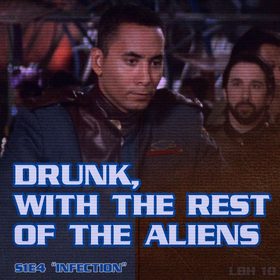
#10 – Drunk, With the Rest of the Aliens (INFECTION)
JOSH Back in the halcyon 1990s, a syndicated sci fi TV series warned us that it indeed can happen here.
JOHN In this podcast, we use Babylon 5 to talk through our current political moment and attempt to process, understand, and perhaps find hope.
JOSH I thought that we might introduce a new feature on the show since we're moving into shows that are not one to one mappable onto current events of just like a Voice of the Resistance, like check in segment at the beginning or like a yeah, yeah, headlines and like, you know, what has happened recently that's on our minds that we may or may not see parallels to Babylon 5, the episode that we're about to discuss specifically or just in general. So today, the day that we're recording, this November 7, 2025, I'm thinking about election day on Tuesday.
JOHN Um, that's definitely on my mind. That's been a whirlwind of a couple days. I'd gone to election day, I'd voted, I'd done my thing, but I wasn't focusing on it at all after that because I didn't want to, didn't want a repeat of last year where I ended up becoming addicted to Doritos. I sat there election night last year, eating my junk food, seeing like, well, if it doesn't go well, treat myself. And that treat myself became a four month duration where I realized the sheer amount I went through of the extra nacho cheese flavor was not good for my body. So I had to make a change. So this year I was just like, all right, let's, let's take it easy, saw some friends, didn't do anything crazy. I was like, yeah, what's going to happen? And then as the night went on, I said, this is interesting. Okay, this is good. What came to mind was that polls seem to be woefully inadequate these days in every direction. So it doesn't matter whether it is a one party is trailing or leading. That seems to flip the next time. The polls just seem to be unable to capture what the sentiment is. And I could probably go on a whole podcast about my theories on that. But seeing the results that I did and how relatively unexpected they were outside of the result in New York, New York was expected, though not a sure shot to 100%, but it was, it was a reasonable outcome. But what ended up happening, which surprised me, was the other elections, Virginia, Jersey, which were both expected to be much closer than they were. So the sense I got was that people are beginning to decide they need a voice again to voice their displeasure, which is A very strong phenomenon in a democracy. The problem with that is that I think the last election was also very much that, is that people's dislike of what's happening in the present will lead them to vote for whoever's not there without necessarily understand the consequence of the choices they have. That's at least my sort of armchair quarterbacking of elections. Off years tend to be a little more based on who has the enthusiasm. And I saw so much enthusiasm. I saw so much enthusiasm in New York for Mamdani. I haven't seen this level of enthusiasm for mayoral election in my lifetime in New York City. I can't. I mean, there's never. You can go back to the 90s when there was some enthusiasm for Giuliana, you know, sort of pre crazy years, but nobody was out there enthusiastic for him. And I'm trying to think of another mayor since who people have been like, yeah, this is who I want to go out and vote for. And who also engendered such a massive negative response on the other side. So what. I don't want to. I don't want to put any out there that's going to be too hopeful. But if we're looking for a metaphor for. Of large, substantial entities that would stand up to what we have discussed here as the rising tide of fascism, New York City sort of makes sense on that because it could be a metaphorical Babylon 5, but this is way early to even hope for that. But could it go that way? What I am seeing in Apparel, which I think is really interesting, is that, like him or not, Mamdani is a figure now in the media, and he's being. He's loved by many of his supporters. There's a lot of hope being poured into him, whether he can live up to that or not. And he's reviled by the other side. They're obsessed with these absolutely false narratives about who and what he is. And I don't even want to justify the horrific things that went into that. But the media was in that, and so was the Cuomo campaign and creating literal AI fictitious versions of Mamdani to try to scare voters. Now it was, you know, they said, oh, this is, you know, this is AI. It was in the bottom left of the screen, I think. But it's wild to think that a major candidate on the Democratic side, ostensibly the Democratic side, would do something like that. But it got me thinking about how Sheridan is portrayed in the media. And that's worth discussing in future episodes that they take not only bits out of context, they Take things that are even in context, manipulate them, or even if there's something that's just outright generally popular, they will just denounce it and anything and everything he says. And I think the same is true of AOC is that again, you don't have to agree or disagree with her. The way that she's been portrayed is fundamentally inaccurate as to the person who she really is and the things she really says. So that's worth exploring is this idea that you're not having a real debate of ideas. You're not saying, I believe this. Hey, I believe this. Let's throw it out to the voters to see who they support more. It's literally misrepresenting entirely and creating this fiction, fictional version of your opponent so that you can win. They had to do that to Sheridan. So I see that as a huge parallel. I don't want that to be the comparison that he's that figure. I'm saying that same techniques are being deployed.
JOSH You know, that's really interesting. Maybe next week. Why don't we do the Illusion of Truth next so we can talk about how Sheridan is portrayed. And you're exactly right. Like the AOC comparison is exactly the same thing that I thought. And there are two things that are kind of hard to deny that they have in common. One which I have seen more firsthand evidence of is just, I think it's an age thing. Almost the entirety of the, like, wacky, vitriolic, completely inaccurate things that I have heard people say about Mamdani. And also AOC comes from people older than Gen X, let's say.
JOHN Yeah, yeah.
JOSH And I think, because the things that they're saying, especially the idea that, you know, Mamdani openly identifies as a democratic socialist. And I think that the education system in this country, the media in the post war period did such a thorough job demonizing anything that's smacked of socialism, much less communism. It's so ingrained. It's like a, it's like a Pavlovian response. You know, it's like a very emotional, knee jerk, visceral reaction that I don't think people can really even articulate. I think that has a lot to do with it. And I think for our cohort, you know, we kind of grew up in the hangover of that, the very tail end of that. But also, you know, the 1980s, the Soviet Union, the whole framing of the ideological global struggle for civilization was like, represented by a country that was clearly on the decline, sort of buffoonish. That was never a very serious threat in my mind, growing up in any real way that I understood, beyond the slogans, beyond the jokes, beyond the stereotypes. And then you grow up and, you know, 9, 11 happens and Iraq happens and 2008 happens, Obama happens, Trump happens. The experience of the, you know, hegemonic liberal, capitalist, democratic order that, you know, won the global struggle for human civilization in 1991, you start to see the, the fractures, the space between what they say it is and what you're witnessing on the ground and how it's actually operating and how, how people are actually living. So I think the younger you are, the less afraid you are of certain labels or certain ideologies. People, young people in particular, who have trouble seeing a prosperous future ahead of them or how to attain it are kind of like, well, this system is not working for me or anyone that I know what else is out there, right?
JOHN Which explains why the younger generations are so much more open things. I mean, it is the fact that we generational memories don't carry over the same intensity and that's for good and ill. So people forget what we fought against in the Second World War in this country, but they also forget. So people say, oh, but they forget how bad socialism is. I'm like, well, here's my answer to that, here's my answer to that statement is that very simply, if you, if you look at what the left, even the far left, is asking for and is promoting, it's something forgotten. They're promoting nothing that is further or crazier than what a standard New Deal Democrat was proposing and supporting 90 years ago. I believe I read a statistic that for 70 years, with only a few exceptions, the Democrats held the House of Representatives for most of the 20th century. And the reason for that was the inertia that they carried through with on the New Deal policies. Very popular and we're not looking at perfect or this is the way it has to be exclusively, but they worked for a lot of what they intended on doing. And they also gave a sense that, you know, that even if you weren't going to aspire to the elite rungs or have the luck to get there, that you weren't going to end up just in a ditch, which is why it was called the New Deal. It was a New Deal compared to. Really what we're facing now is like, hey, we're now going back to pre New Deal before there was a deal where there are no guarantees. Everything is chaotic and crazy. So I think that we, when we see this sort of longing for that Again, and maybe it's called democratic socialism, maybe it's just called this. It's because generally it became something we forgot in this country. We forgot what the New Deal was and more importantly, we forgot what was coming after as Roosevelt was dying, the fair Deal. I mean, Google that is fascinating. And Truman trying to implement pieces of that early versions of Medicare, including desegregating the military. All of these things that today would be viewed as oh my God, that's so far. That's so far left. And it was the mainstream of what won us the Second World War and did largely unify society here again with a caveat mostly along racial lines, because that was still a big component of society back then was racism at every level. But the general policies weren't far out there. So it's just ironic that on the right they're doing the same thing. But they're not out of this world either. Because Nazis were in Madison Square Garden. The level of support for Germany before the Japanese attack on Pearl harbor was astonishingly high in this country. So it's like both sides are recovering a bit of that or I guess either they've forgotten it or they're recovering it. Who knows? You can put it either way probably. But it's really strange to see that manifesting and if people were educated about their own history that hey, both these things already happened. I wonder where we would be in that case. I mean, stories like Babylon 5 are literally based on what happened. New tellings, trying to get new insights, but also explore, you know, the reemerging patterns. And the show that we're discussing here is what JMS puts forward is that the pattern of authoritarianism, of fascism and that descent into darkness doesn't go away because we go into space. It actually just goes. Operates on a bigger scale. That's why he wrote in so many parallels. And I think that's. That is realistically what we face now. You look at the way corporations operate and that's going to. That goes right into this episode is it feels like the sci fi of the 80s and the 90s, that sort of dystopian corporate world future. We thought we were going to get around that or something better would happen. And here we are at the beginning of that. So memory is a weird, really fickle thing. And I like the idea that the younger generations are exploring new things. I'm just very worried about those who are going full on fascist, I mean full on Nazi or full on comparable to that, you know, people who I shall not name to platform them here are gaining major entrance into right wing blogosphere and media outlets while being outright Nazis tells you something. And that's why again, you're watching this show, we're watching it in the mid-90s and they're making references to. Go back to your Bund meeting, you know, for the night watch officers who are wearing armbands and are obviously meant to be the brown shirts followed by the Nazis and everything around that. And you're watching so. Well, that's. But that wouldn't happen again. That's just, that's silly. I, I really, I would like to dive into more about what JMS thinks about. Was thinking back then about how much of a cautionary Talos was compared to some other authors who didn't think it would actually happen. I mean, Margaret Atwood is a great example where she didn't think her book was in any way prophetic. She, she says this is a work of fiction based on the cultural tendencies I've observed in the American population from my perspective as a Canadian. And she actually sort of made a quasi apology for that, saying, whoa, I really didn't expect this to actually happen. I'm sorry I downplayed the reality of it.
JOSH Well, you know, you said a few interesting things that I want to, I want to magnify a little bit. First of all, I should say the episode that we're going to be talking about is season one, episode four, infection, which if you're a Babylon 5 fan, I think there are two episodes that I can think of that are pretty much universally recognized by Babylon 5 fans and JMS himself as not good. One of those we are covering today, Infection. The other one is Grace 17 is missing, which we will absolutely get to in due course. Um, I've been bringing up Infection to do for a while because I don't know, I'm just really curious about what we'll see when we subject it to this microscope lens that we have been watching the show through and watching it yesterday, I very quickly realized there's a lot here and something that you said about how, you know, what the show is saying is that when we go into space, we bring all of that history and human nature with us. It just happens on a grander scale. Scale and for some context. So Infection was the first episode of the series proper to be produced after the Gathering, the pilot movie. So in a lot of ways, even though it was aired as episode four, this is in a lot of ways the first episode of Babylon 5. And it lays out a lot of foundations for ideas that are central to the overall story of the show. The end of the episode, there's a scene between Franklin and Ivanova where I forget exactly the line, but he talks about, like, the growing anti alien sentiment back home on Earth and whether this, you know, radicalized, fanatical, genetic purity monster that they just defeated in the episode was a preview of what was in store for them. And then the very next scene, the ISN interviewer, she asks Sinclair, like, what are we doing here? Why is Babylon 5 worthwhile? And he makes the opposite case. So essentially, in the last closing five minutes of this show, you have JMS saying, history, the ugly parts of our history will repeat itself or will try to repeat itself. And right after that, the closing statement of this very first episode of Babylon 5 that he's writing is saying, why it's worth it, why the struggle is worth it. And I thought that was very, very interesting. It stood out to me in a way that I don't know, it would have stood out years ago. And yeah, I mean, so many things in this episode, which again, is a bad episode and not without reason, I understand. Like, I was reading one of JMS's commentaries on this episode, and he talks about how every sci fi TV show at one point or another has its man in a Rubber suit episode. And that's more or less what this was. The, like, plot, quote, unquote plot, is the weakest facet of this whole episode. Beyond the plot, everything that it's setting up in the background, narratively, what it's setting up in the world of the show, what it's setting up thematically, is really rich. And you said you really want to dive into, like, what JMS was thinking in terms of how he viewed the likelihood or the social political forces at play that would make a descent into fascism more or less likely. And what this exploration that you and I are doing right now into the show has made me realize in a way that I never really, like, really internalized or really saw was how fundamental the descent into fascism narrative really is to this whole series. Like, it's not something that's incidental, or it's like the story because it's a cool idea. And like, Star Trek would never go there. And like, you know, what if we do this? Like, these are concerns that he felt very strongly about and were really foundational to his whole idea and concept of this five year sci fi story arc.
JOHN It does. Watching it for the first time in many years, it was not an episode I'd gone back and revisited in the Past. And I think for all the reasons you've already said, revisiting it with the intention of discussing it and with the intention of looking at the episode, not just watching it for the sake of watching it. I got all the things you just said. I got all the, all the breadcrumbs that he put in that episode. Like, oh, now of course, I would not have picked up on that at all watching it the first time. Because when we watched this show the first time, we didn't even know that this was an ongoing story of a show. We didn't know that James deliberately snuck that in. He didn't let the studios, didn't know that was his plan. He marketed it like Star Trek episodic wagon train to the star type stars type thing with a darker hue to it. So this was the first time where, yeah, those little bits are being layered in there for use later. And it actually pulls off really, really well. Knowing that this was the first episode filmed also helps me get through that because I'm like, oh, well, it's weird if you're going episodes 1, 2, 3 and then this where you're like, why are the characters more wooden? Why do they not seem to like, be the same as they were before? Oh, because this is their first time out of the gate and it had been almost a year since the pilot had been filmed and there were a number of cast changes. There was definitely a style change, a vibe change. So they were getting into that. So now I can forgive that and look at it the way I look at other prequels. I can look at it and say, oh, they're getting their feet into their roles. It's cool to see how that happens. But yeah, as a viewer, you'd be like, what? This is just sort of like, you know, mediocre sci fi, whatever. You're right. Man in a rubber suit type thing. And JMS himself said he didn't want it to be about the man in the rubber suit, but obviously that's what happens. He wanted it to be about the type of people who would build that type of weapon, not about the weapon itself. But it can be forgiven because, yeah, this is the first time he's writing his own show and trying to, trying to do this and then later succeeds so well. So I can forgive a lot in the episode. And so overall, I sort of enjoy it for what it is. But again, taking from that perspective, this is not an episode I recommend to anybody. As like, here's a. You want to go have a fun time with science fiction in particular, JS's writing in Babylon 5. No, you don't show them this from Mars perspective. Very cool. This is really useful. And that end line of Sinclair where he says, you know, yes, we have to go out to the stars because scientists never grant anything except that the sun will go out at some point. Whether it's 10,000 or, you know, a billion years, it's going to go out. And if we don't go out there, all of this was for nothing. And he says, and I distinctly remember feeling that, because this is a play on other quotes that have come, you know, Carl Sagan and others, when he says, when that happens, it won't just take us, they'll take Marilyn Monroe, Lao Tzu, Einstein, Maripucho Body, Holly, Aristophanes. All of this, all this was for nothing unless we go to the stars. And that's like jms, like manifesting in the show. You're like, oh, okay, this is where the rest of the show comes in. And it's her grand style of writing. But even back then, I remember that sticking out to me. And for the life of me, I didn't remember that. It was in this episode. I could have sworn it was in a different episode that he said that, because I didn't associate anything particularly deep this episode. But here we go, let's get into it. This episode had a lot that he put into it when it starts off. And yeah, it's a little rough because, you know, you don't really know what's happening or why, but, you know, it's just a, oh, somebody's coming in on customs on the station. Station looks great, by the way. I mean, this is the first episode filmed. They had the look down and they didn't change it for four years. They had actually mastered that part. Going right into this episode. The uniforms, you know, corridors, the lighting, everything came together for what we knew as Babylon 5. But I'm there watching it and rewatching it, and I see when Nelson, who later becomes the man in the rubber suit, takes out the security officer who's doing customs. And so he seems to know or whatever and, you know, gets a little suspicious. And I'm looking at this, I'm saying, could they have chosen any more of a typical 80s 90s looking bad guy? And then I'm like, no, they couldn't have. They actually could not have chosen somebody more appropriate because where did the actor Marshall Teague, like, what is he known for? 1989 Roadhouse, he's the villain. And Roadhouse opposite Patrick Swayze. That is definitively that era of TVs and movie. Like that over the top, corny, 80s, like, bad guy thug. You know, the hair. Every way he looked and it was just hilarious. And then, you know, he goes on, he's. Yes, he's in this. And he take. He takes on later characters in the show. He's Talon.
JOSH Yeah. Right.
JOHN So he takes on this very, you know, the Narn warrior monk archetype and does really well with it. But in this, I was like, this is so classic for that. It's like he's chewing the scenery with his, like, villainy but pretending not to be a villain, you know?
JOSH And on the other end of the spectrum, the other guest star, David McCallum who nailed this, like, so something that I realized because, yes, this is the first episode produced it kind of feels a little Uncanny Valley a little bit because you're like, yes, this is Babylon 5 but it's also, like, proto Babylon 5. And something that I realized, actually, later on was none of the ambassadors are in this episode. No g', Kar, no Londo, no Delenn. So one huge component of, arguably, half of what makes this show so compelling is not even in this particular episode. And I remember, particularly in season one not all of the actors were contracted for all 22 episodes. So you would have episodes where certain characters wouldn't appear which makes sense because it's supposed to be a city in space. So, you know, they wouldn't all have a notable storyline happening every single week. But, like, normally, you have Londo, but no Delenn. Or you have Delen and Londo, but no g' Kar to not have the entire ambassadorial wing say nothing of their assistance because that's something else that happened later on. If you don't have Delenn in this episode but you have Lanier you don't have Londo, you have Vere. But that was something that, as soon as I realized, I was like, oh, well, that explains a lot why it sort of felt like more Star Trek in a way. Like, the point of view is 100% from the Earth military characters. It's not about the internal politics of the Minbari or the Centauri. It's like, here is Earth, here's the alien of the week. He's blowing up our ship, so we have to blow him up first. And I had another thought. Oh, yeah. No, no. David McCallum, who American viewers may recognize from his last notable role I think was in NCIS on cbs. He's a really fantastic actor. He was on the man from Uncle. He was on this amazing British sci fi show called Sapphire and Steel, which, like, there was not anything on TV like it then and there certainly isn't now. It's like a very moody, very strange kind of supernatural show where like they don't explain anything but like the mood of it is. So. Yeah, well, anyway, and then he was also, memorably for some, he was in this very famous episode of the Outer Limits called the Sixth Finger where he basically evolves into. Into the next stage of human evolution. And the photo of him and all of the makeup is like one of the handful of iconic images that you still see from that show. So anyway, the point of all this is to say that he really had gravitas that he brought into the show. Like the way he's able to say all of these lines with such believability about this alien technology and like this corporation you've never heard of and all of this stuff. It's a lot of exposition, it's a lot of technobabble, but he sells it like you believe he is this guy. And I have to say, the guest star on a TV show, sometimes the guest star of the week is not up to snuff, as we say. But here, like he's a guest star that is really carrying a lot of this episode. In an episode where we don't have d', Kar, we don't have Londa, we don't have deland, it's sort of like the gravitastic void is filled by him in this episode.
JOHN Yeah, he. He does that really well. And it's funny because again, like he was making all the rounds in 1993. Right. As this is Aaron, he's in an opposite in an episode of Sequest, you know, which is oh really the same year for. So for those who are watching the show back then, you'd know that this was the age in all these shows. 1993 was this golden age for sci fi. You have Deep Space nine, you have Sequest, you have all these other like alien sci fi shows coming out. Most of them did not make it past one or two seasons, but it was a great couple years at least. You know that we had this. And Babylon 5 stood the test of time and lasted. So I'm glad that, glad he got to get all his roles in before nailing that multi decade NCIS career. But he had, he did have the gravity for it and he was a villain in a way that I didn't think of when I was watching the show originally I thought he was just like, all right, he's just doing his thing. And O, you see the disappointment, you see the disappointment in Dr. Franklin to his old mentor. And again it was okay. Were they trying to copy Captain Picard here? Because it's like, oh, archaeology. And he was his best student in archaeology. I'm like, this is the same time. This is. This has to be the same year that the two parter episode in Next Gen where Picard actually wasn't a two parter.
JOSH It actually wasn't.
JOHN It was a one parter.
JOSH No, it was a one. There's a single episode, I'm thinking the.
JOHN Other of that season. You're right. Picard going off and doing his own thing. It's when he's under undercover. But it's just so funny that the same thing was taking place where it's like, oh, archaeologist professor comes back to the. One of the lead cast members of a sci fi show come off and do things with me. Both with very different intentions to that. But this was sort of funny. I'm like, yeah, I guess these tropes go around. But I guess that's why I also must have like grafted on the memory that oh, he was a good guy. He was one of the victims of the mad machine of the Icarus and nope, he was a villain in the most important sense. And what was David McCallum's character's name again?
JOSH Vance Hendricks.
JOHN Vance Hendricks. And what got me was that he first he's just able to. Dr. Vance Hendricks. Right. So casually lie to his student and friend. One assumes that casualness, that even ease of which it comes and then always have an, an explanation. Most people have encountered people like that in their own lives and that is somebody who's profoundly dangerous because they get right under the radar. And you'd think, okay, well, he's a doctor, a PhD archeology, you know, good guy. I had students who were inspired by him and turns out, no, he's just literally in it to become fabulously wealthy doing something that is not only like against the rules. You know, you can debate that back and forth. He sort of tries to make it out like that. Well, you know, we're not taking shortcuts by raiding these archaeological sites and using their. We're just accelerating progress and this is the right thing to do. Oh, but you're putting people at risk. Oh, well, you know, it's for the greater good. It's for, you know, we're going to get these things out there. It's going to be really important. Oh, no, it was for Interplanetary Expeditions. And he was playing his own game to hold it back from them to become obscenely wealthy. And that's what he talks about at the end of the episode or the end of his arc. It's like, can you imagine what you would do with that amount of money? And the truth is, most people, probably almost any of us tempted with that much money would do some pretty life endangering things and not their own life. And that. And that's why he's such a accessible villain, especially for that era of tv, is that he's just the. He's the evil capitalist gone crazy, you know? And he talks about it in such a. Again, a casual way that he can dismiss any concern you have is, don't you see how awesome it would be if we just make a ton of money?
JOSH You know what's interesting, too, is that. Well, a few things. Like, when I was watching the episode in my head, I was like, okay, so this episode is about ideological and genetic purity and why that's impossible and why going down that road is not only horrible for everyone else, it's also folly for yourself because you will end up destroying yourself. But that's actually not the only thing this episode is about. It's also like, you're just saying the motivation for the villain here is greed.
JOHN Got money, plain and simple.
JOSH Which, you know, is interesting. It's not necessarily a motivation that you would find on, like, say, Star Trek outside of the Ferengi, but that's usually played for laughs. Between that and, you know, again, laying all this groundwork, he talks about IPX Interplanetary Expeditions, these mega corporations that are players in the Babylon 5 universe. So it's not a moneyless society that is motivated by some higher calling about exploration. It's like, you know, you have corporations raiding extinct civilizations for technology that they can exploit and sell. And there's a weird connection there, something that I thought of with the ostensible main villain, the man in the rubber suit. What was his name again?
JOHN I don't remember the character's name. Nelson Drake. But then he's the weapon, but he becomes.
JOSH Yeah, he has, like, the personality matrix of its creator. Yeah, right, right.
JOHN Yeah.
JOSH But anyway, the man in the rubber suit, he. I just completely blanked on what I was saying. What was I saying?
JOHN That intensibly, the villain is supposed to be the man in the rubber suit when in fact.
JOSH When in fact, it's the greedy David McCallum character. The thing that I thought when they Introduced this idea of this organic technology that merges with a human host to turn the person into a weapon. The first thing that I thought of was neuralink. And then I realized there is some crossover here between, like, an Elon Musk figure who is part of this broader Silicon Valley transhumanist thing where, you know, they see humanity's future as a future where we no longer exist as biological entities purely but as digital consciousnesses merged with machines that carry us into space and we take over the universe and, like, try to, I don't know, reverse entropy or something.
JOHN But instead it becomes about becoming a. A weapon which you see not only with neuralink and. And Musk's own devils is that you see that better represented in companies like Palantir, which is. Which is the other major one of today to look at where it is about using these kinds of technologies for weapons use. They're the ones creating Skynet. And the Terminator effectively is them. And Dr. Vance Hendricks goes through that same process himself because he starts off trying to convince Dr. Franklin to be involved in this under that idea, which I'm sure he also believes. These aren't oppositional beliefs, nor is it oppositional. When Musk talks about them. He starts off with a sales pitch of like, look at this amazing organic technology. We can't do this on Earth. We haven't cracked the code. Vorlons have. The Minbari look like they've done it. What are we. What are we doing here? And look at the potential here. And knowing that he's talking to a doctor, like, medical applications, everything else, it's meant to point out, yes, there are some of those applications as well. And then the revelation is, oh, it's not a scanner. You know, this is not a medical device. It's not anything like that. This is a weapon. This was developed as a weapon to get technology can go in any of those routes. And what is the logical consequence of that? And why does that parallel to greed? Where does that go into it? And then the big thing, which you've alluded to a few times which is sort of the second half, big chunk which happens in the later half of the episode is the notion of species, racial, ideological, religious purity and why this weapon was created in the first place and why all that does ride together in the same cart. The greed, the corporate influence, the idealization warped by the promise of massive profit all put into something that is ultimately used and even in our world today is used for the sake of ideological obsession which we see in these tech oligarch. Figures. They have all those qualities. They have these absolute ideological obsessions. Check out again of the two companies we've just mentioned, Check out their leaders, check out their ideological obsessions. And I'm going, I'm talking about beyond politics. I'm talking about their quasi religious obsessions, which put sci fi to shame in terms of their almost fantastical obsessions. And that's all put in here. I don't know if JMS is trying to literally get everything possible through that. This is just what's always on his mind. So these elements bleed through and come into the story. But it's really neat to see in the context of a later show because the show deals with this idea of what happens when you have regular people operating from the premise of greed and just, hey, you do things because they're advantageous to you, not seeing where the end is. And then that machine itself, that weapon itself that Nelson merges with and becomes part of, is itself just the logical conclusion. Of course, what happens, you take the Ikarans, not to be confused in my head with the Iconians who are from Star Trek, keep on trying to separate that out. But the Ikarans, who were themselves victims, they had been invaded, I think they said, like 12 times or something, by other alien invaders in their part of the galaxy. And so they developed a technology to defend themselves. Now, what's interesting is that again, you can take that notion by itself and have a fine story. Oh, it's a defense mechanism programmed poorly, and it went crazy. He didn't stop there with this. He didn't want to stop with the idea. That's completely reasonable in a sci fi context, that, oh, you created a weapon that got out of your control. The reason it got out of control is the more compelling part of the episode. They talk about the high priests of their society, you know, trying to figure out what does it mean to be a pure Akharin and debating it and then encoding that into a machine and then that encoding programming, never finding a fully pure Karn and wiping them all out as a result. Yeah, that's. He's literally discussing. They use the term. Oh, that's what the Aryans did back when. So there we are, back to that. It's literally first filmed episode of Babylon 5 is referring to the Aryan obsession of the Nazis. Like, there you go, we're talking about it from filmed episode one, episode four of season one. You know, that's what the show is, is about. It's about looking at that era through the lens of the future. So yeah, we're talking about Nazis in 1993 in the first episode here. And that was something that jumped out not only yesterday, but saying, yeah, the. The absolute insanity of that pursuit and where it leads one in the end. And yeah, it's a guy in a rubber suit blasting things with an arm cannon of electricity. But the notions.
JOSH Something kind of charming about it, though. Yeah.
JOHN Yes, it's like a throwback to like that good old sci fi that doesn't, you know, have to try too hard, but also sort of works, but can touch on the bigger issues. No. So it's really interesting. And then, you know, Michael o' Hare chewing the scenery, yelling at the person, personality imprint of the suit. Like, you see what you did? Look at Nelson's memories. It's a dead world. You did this. You did this. And like realizing it and shutting down and taking it off.
JOSH Yeah, yeah, he definitely went to the Captain Kirk school of talking a computer to death. That's sort of what that reminded me of. Or like the Doctor talking Dalek into self destructing.
JOHN Right, Right.
JOSH No, yeah. Like there was this long exposition scene where Franklin was explaining the backstory essentially to Sinclair while Sinclair is, you know, suiting up and on his way to.
JOHN Yeah, I'll live in a minute.
JOSH Yeah, so. But actually, to the director's credit, the way he shot it was actually very nice.
JOHN He.
JOSH They walked through a lot of different looking locations and the lighting was actually very stark and he was utilizing the space. So I was actually like, he's trying. He's trying to make it work. But Franklin had some lines that really hit me in the context of 2025 and everything that we've been living through. Yeah. The ones who were responsible for programming this weapon on Cara 7, Franklin said they were religious fanatics and military extremists. And he said they programmed it according to ideology, not science.
JOHN Yep, yep.
JOSH That phrasing, those words post Covid, you know, rfk, like trying to outlaw vaccines or whatever he's doing is, like, really more salient to me right now than I think it ever was. The idea that it's like, well, here's the world we want, and we have a machine that can help us make the world we have more like the world we want. So let's not worry about the facts. Let's program it according to what we believe. And then, you know, what ends up happening is their machine was like, well, what you believe is impossible. So I just have to dismantle your entire civilization in an attempt to realize your insane ideology. And. Yeah, you know, it was interesting, Sinclair's Michael Ohares performance in that whole sequence. You know, you can chalk it up to adrenaline. And as Garibaldi points out later, this is sort of the kind of situation where Sinclair really comes alive. He sort of lives for these moments where his life is on the line. No pun intended. But yeah, like I was thinking from the perspective of 1993 when they filmed this episode, like, what was Michael O' Hare thinking? Because, you know, today, given everything that we see going on in the world, very close to home, I could see an actor playing a scene like that and really getting into it because it sort of hits home a little bit. I'm not saying that everyone would have shared this perspective in 1993, but in the early 90s, for, like a straight white man, that whole idea of racial purity and all that was something that happened in the past. So I was just wondering, because he's really fiery in that whole monologue. I was like, what is he drawing on? Like, how is he getting himself to that place?
JOHN I think it speaks a lot to the 1990s, though. And I try not to look back too much through rose tinted glasses. It feels like from my recollection and experience the 1990s is that there is this idea that we're not there yet, but we're certainly past the idea of where we think of racism as being acceptable.
JOSH Sure.
JOHN So there's a duality of, oh, there are plenty of racist people out there, there's plenty of racism in the world and in the things, but it's just no longer acceptable. So we generally. We wouldn't promote that in a TV show. We wouldn't promote, you know, the idea that these things are okay. Are there still plenty of racial stereotypes? Yes. Are there plenty of problematic things? Yes. But it wasn't viewed as anything that was insurmountable. And it was a foregone conclusion that we were heading in one direction even if we weren't there yet. And I think that's what the 90s are. We're not there yet, but we know where we're going. What happened more recently in the recent decade was. Or decade, two decades, is we started reversing course in reaction to the sense that we're already there. Maybe it was a bit of the reaction to people being very much policing of language, but it was because the assumption got dropped at some point that we were just going to continue going that direction. Resentment built up. Well, why do we have to go in that direction? I don't think people this to the Same level were challenging that this is where it's going to go even if we're not there. As we began to approach that, and I'll say this, once we had a black president with President Obama in 2008, things really seemed to reverse course and the dialogue shifted back to, well, why isn't it acceptable to stop or reverse course? Why do I have to think of this way anymore? Can't I just go back? You know, wasn't there some benefit to the past? So the 90s are, you know, I can't remember any TV in the 90s that was anything short of what we might call Proto Woke.
JOSH Sure, yeah.
JOHN Even the cartoons of the 80s. It's something very different from now. So an actor thinking about, where am I right now? It was sort of a default. It would almost be a default indignation of like, well, why are you doing it this way? Why would you, you know, order yourself out? But what's in this show and what's in JMS's writing is it's not a foregone conclusion. That's where we're going. We're not just going to a more peaceful future. Post racism, post conflict and post more important Hierarchy and Friend vs. Foe obsessions, which is what the right wing, for many reasons, and that term is very important to them based on their own obsessions with fascist ideology. They need friends and foes. They need to know who the foes are, identify them, create them if need be. That's where this show goes. Towards the end. I mean, at the episode, I should say, is Franklin saying, like, I'm wondering if what we just saw is a preview of things to come and make specific and explicit reference to Earth first groups. Isolationism growing and growing. So. So he's saying, like, oh, yeah, that is a big thing happened. And then you get the hint of that from the reporter again. You put the pieces together. It's there. J comments. Comments on it later. Yes, it's there. This isn't overstepping. The reporter is coming from a standpoint that we're familiar with in our time, which is, you know, the people back home are asking about space these days. What are we doing out here? Isolationism is growing and the resentment of other people. And this idea, which is again, very tied to a capitalist in space idea. Why are we paying for this station? She outright says, shouldn't we be taking care of the problems we have back home first? Well, okay, that's. We've all heard that before. We're hearing that every day now. And it's also one of the most disingenuous statements when somebody says to you, I don't want to help those people abroad or over there because we need to focus on helping people here. You can guarantee 99 out of 100 times they will absolutely not help anybody here. And it is such a strawman argument and is so deceptive in what their actual goals are. Sure close. Babylon 5 is anyone's life. Go on Peruvian Earth Dome. No, that's the argument that's made. So when you hear that today and people say, oh well, if we just cut off foreign aid, if we just cut off worrying about all these other people, well, you cut off worrying about people who don't deserve SNAP benefits, they don't deserve this. Everything else is going to get better. No, it won't. But more people will suffer and your society will continue to destabilize. And I think that this, that's something that was still very present in the 90s, that that's an onward thing. As far as you can go back is we don't, you know, we don't want to look to the outside for anything. We don't want to, we don't want to help the non us. Babylon 5 is at the center of that conflict of who do we help?
JOSH Yeah, it's really true. You just made me think of Mamdani again. Something that I've been hearing a lot of people say like, you know, well meaning liberals even talking about him and his policies like free buses and the universal childcare and all that. And they say how are you going to pay for it? And I want to be like when they talk about hiring, you know, another 5,000 uniformed police officers in the city because your first thought, how are going to pay for it? I don't think so.
JOHN None of those well meaning people, as you said, not a single one of them asked that question of Andrew Cuomo in terms of the 5000 cops. It's your perspective, it's, it's everything else. And it is very possible that those policies either can't get passed or don't work out as well as intended. I think the big difference, that it.
JOSH Shows where your priorities are.
JOHN It bingo, bingo. It shows your priorities, what your orientation is towards. What am I most concerned with? Am I concerned with the well being of everybody? Am I concerned with the well being of some? And that's that, that's not ignoring what is the number one polled issue for New Yorkers, which is public safety, no doubt. And that's going to be in a city no matter how much the crime has fallen since its peak in the 1990s. There's nothing in the 1990s. Crime was at its peak when the show was aired. New York City was probably at its worst in the last 40, 50 years. And we weren't thinking about it every day like that. So you're not going to ignore that. But isn't it interesting that when you're talking about, oh, public safety or anything else, there's no question as to, oh, well, we'll just find the money once there's a will to do it. Say, well, isn't that same will going to be there on the national level? We can afford tens of thousands of new ICE enforcers with 50 to $100,000 bonuses, salaries of $100,000. And you're like, so we can't afford 10,000 teachers like that. Yeah.
JOSH And I mean, it's interesting too because police are like, how do we protect the law abiding citizens from the lawbreakers who are committing crimes? And how do we mete out consequences for committing those crimes? On the other end it's saying, well, if we make life a little easier, services more accessible, life more affordable, more, maybe fewer will resort to crime.
JOHN Yeah. The logical extension of that is what we're seeing today. And again, we've seen it from the center left all the way to the right, which is the criminalization of homelessness. Yeah. Which is, it's absurd from just based on simple logical premises. So you take people who either have lost everything through any number of means from mental health to simply a health crisis that bankrupted them, which again, only country in the developed world where you can go bankrupt from a health crisis for your medical expenses specifically and say, okay, well those things happened, they're homeless. Oh, they're going to be arrested for existing now.
JOSH Yes, right. It's so stark because unless you can justify your existence and figure out on your own how to pay your own way, then your a criminal and we would rather not have you here.
JOHN Right. You either have to go somewhere else or not exist. It's very stark. And this is a question that Babylon 5 deliberately did not address in terms of like, oh, well, how does that contrast to a post scarcity world? There's no real discussion. Yeah, there are more advanced species maybe of a bit of that. The Minbari don't seem to have the same worries, but they certainly have the same cultural breakdown that the rest of the show and that Earth alliance experiences in their own civil war in the fourth season. So maybe you have a bit of that with a Vorons and the Shadows and some of the other ancient ones who just sort of float around that they don't have those problems. But that's not the concern of the show. But it's about addressing what we are when we're trapped in this world of, okay, so how are you going to treat people? How are you going to orient yourself towards that? And that's where the idea of, you know, we take Delenn's approach towards everybody and the building of a great alliance of all these disparate alien species, what that is in comparison to this continued inward looking idea and why the very Clark regime we've discussed so many times on this show is obsessed with the language of law and order. The language of law and order. Not the actual application per se. They're just brutally imposing their will. But they use the language of law and order as if it is a proxy for morality. It's a proxy for what's righteous and right even though they get to define it and redefine it and. And give their cronies a pass at every single occasion. Which was where this episode ends. Who shows up at the very end of the episode? Two random security officers, whether Garibaldi's or somebody else's, you don't know. But they were under orders from Earth Force Defense, which I think that was later sort of renamed some of those things, but the bioweapons division to take the Occurren artifacts. So Earth will now have their own biotech to study, which sets up, you know, yes, they're involved in the Shadows later, but it sets up their bio research that they're not only looking for, but they actually get it by season four. And they outfit their own battle cruiser. Was the war no Warlock class or was one of the other classes of.
JOSH Right, right.
JOHN The ones that had the Shadow skins on them, basically, the Shadow spines, you know, so they're looking at this and that sort of ruthless notion. So it's a bioweapons division. It's not going into. How can we use this for the betterment of people? It's why we got to defend against those scary aliens. Sure. You know, but if that's going to be your orientation, your focus of what you're going to do with technology, what you're going to do with people, where it's going to end up. Oh, definitely somewhere closer to the Shadows. Something where you are inviting conflict for the sake of conflict. And again, the core arc of the show, the Shadows, the Vorons, is conflict versus, in theory, cooperation. The Voronlans lose their idea. It becomes less about cooperation than it does about becoming stagnant and just not fighting.
JOSH Yeah. And also for them, it becomes about the game that the Shadows and Vorlons have been playing over millennia, has become about the persistence of the game.
JOHN Yeah.
JOSH So when you see that, like, in the Vorlons, like, it becomes personal for them. Like, they're almost just as interested, if not more interested in winning against the Shadows than they are shepherding the younger races. Like, it's about their standing with the Shadows and the score in this conflict.
JOHN Anomaly discovered.
JOSH Standby.
JOHN There we go.
JOSH We just had a technical malfunction, a bit of an interruption, and we're back now. I'm not sure. I'm never sure if I want to acknowledge that in the episode itself, if people care.
JOHN It's just a hard cut to, like here. Going to the next thing.
JOSH Right.
JOHN I have a couple of last points on this episode. Where. Where were you at last?
JOSH Again, I remembered not loving this episode that much, and I knew its reputation. One thing that really struck me is the degree to which it is so well constructed in terms of seeding all of these major plot lines and major elements of the world that would factor in later. And yet when you were watching this in 1994, you would see none of it. And it made me wonder, you know, given where we are now in the end of 2025 in the United States, I wonder what things maybe were happening that we disregarded or didn't take seriously or didn't see the relevance of that led us to this moment. You know, I think broadly speaking, the idea that, like, what happens on the Internet is not real life. Like, that is clearly no longer true. Like, the Internet is real life and real life is the Internet. I think that the cesspools on the Internet that breed the most vile viruses and infections can jump from virtual world and spread into the real world much more quickly and easily than I think we thought was possible. I think the other thing, too, is probably just like the rise of social media.
JOHN You know, I think the show parallels some of that in its discussion, not in its production. JMS Starts is one of the first major television producers, writers, directors, etcetera, to have a direct interaction with legions of fans outside of conventions. He there he was on the AOL message boards and then later, you know, even active on Twitter, all kind, you know, every platform until about 10 years net now on Patreon, which is much more gated because it. To quote Cory Dr. The entire thing, Internet, all these Components of social media got inside. But he was there as a pioneer discussing this show with details of details for these casts. I always have the lurker's guide up at the very least, to look at those things that he said and all those back and forths on the message boards. It's amazing you don't have that for other shows. Now he's. He'd taken a little bit far. I don't know if you heard about recently. There's a website, b5books.com, which I only recently learned about. They just closed their doors. They had published tons of books and works on Babylon 5 in collaboration with JMS. And a lot of his commentary, updated commentary.
JOSH I have some of them.
JOHN Very nice. I did not nab them before they closed, sadly. So I will have to rely on the goodwill of others to get those.
JOSH The only thing I have are the script volumes. I have a handful of the other things, but ultimately those interested me less than JMS's commentaries and the scripts themselves. And then I also have the other voices volumes that's the same format. It's a collection of the scripts, primarily from season one and season two, that were written by writers other than jms.
JOHN That makes sense. I mean, that's the best of it. But it is sad to see the end of an era for something like that. So, I mean, there are just so many extraordinary resources and things for fans. It's absolutely wild. And I think that, you know, knowing that and seeing how he took advantage of social media, of the Internet, especially at its inception, and how that's changed and how he's pulled back from it, is a direct mirror to what we're seeing now. You're right. It wasn't just out there in the ether, out there in cyberspace. It's had such a profound effect on us. And all these shows, Babylon 5 included, had computers very much in service to us. And they were really just extensions of what we imagined computers would be in the 80s and 90s. It's a different. We're in a different future. We may not be integrating with them on the neurological level with neuralink yet that's coming at some point. But they're integrated to our lives in countless ways and they're influencing us and warping us in ways we never anticipated. So would there have been episodes about that? Oh, definitely. There are allegories to it here and there you can probably create. But it's a scary thing that I think the warnings that the show contained weren't because it was saying, this is going to happen. Tomorrow, but it might happen the day after tomorrow. And we're there now. We're there now. We're seeing the nativism, you know, Earth First. We got to focus on our own authoritarianism. The suspicion cast everywhere. I mean, people are so incredibly suspicious. And this episode is weird in that sense that the vibe you get from that reporter is one of such skepticism. Lloyds of London 501. Yes, Babylon fought one through four were destroyed. Well, four vanished into another time, as we know. But why is there this constant push, pull tension in human beings of let's go try to accomplish amazing thing. Oh, no, we shouldn't do anything like that. We have to look completely inward. These elections this past week are literally those two forces manifesting and conflicting. Let's try to reach out. Let's try to do something. Let's try to be incredibly inclusive and progress. And the other saying, oh, no, we don't do anything like that. We have to completely turn around and look inwards. And we need to find out who our enemies are and punish them. I think the scariest thing is people who need that is when they're told there isn't an enemy at this moment. So you create one at this point in the show. Yes, we know in hindsight, the Shadows are beginning to wake up now, ironically, because of Interplanetary Expeditions, the shell corporation, front company for weapons, bio research corporations that work with Earth Dome. That it's Interplanetary Expeditions that wakes the Shadows up.
JOSH That's a good point. That. That. Yeah, I don't remember exactly. But later on in the show, doesn't Delenn say something to the effect of they're returning sooner than we thought and we don't have time to prepare. Like that is because of these same forces, this, you know, profit motive, plundering for secrets that they can exploit. Yeah, it's because of ipx.
JOHN It's because of ipx. And they're really dodgy ways of doing things. And it's. Anna Sheridan got sold on. On. On the vision that they were promoting, which was the positive. Oh, look at progress while being incredibly cynical on the back end for profit. So there she was, you know, and as a result, she herself became corrupted by the Shadows in a horrific way. Wow, there's a lot there. What, you know, you have to wonder, was that just one of the throwaway lines that this is going to be ipx? No, no. Knowing the shows, we know it. I think that was designed to be. Yep. Here's the first time we mentioned ipx. And then as it comes out there it is. There's Mr. Morden and Anna Sheridan and it all comes together. But you're right, that's the scariest part, is that the Shadows were going to come back, but is it because of companies that came back quicker?
JOSH I was reading JMS's commentary in volume one of the scripts they published, and he was saying the technology of that Akaran weapon that merges with Nelson, you know, you see the parallels between how that operates and how we learned the Shadow vessels also operate. And he was saying, if you view the Shadow vessels as like the Air Force or the Navy, that weapon is the infantry. And he was saying that that was absolutely Shadow technology left over from the last war. So the intention, I think, in his mind was there the idea that, you know, he really is seeding things for very specific reasons.
JOHN Yeah.
JOSH Not even just thematically, to get you used to the idea that, like, there's organic technology and it can merge with human hosts to create a weapon. It's literally the same technology that they will be facing later. I thought that was very interesting. The other thing, too, you were talking about the sort of antagonistic stance of the reporter. That read very realistically to me in terms of you can tell what a reporter personally believes when they're in an interview and they're playing devil's advocate, like how well they play it. And from how she came off sort of antagonistically, asking these loaded questions, you're like, oh, so this is what people on Earth are seeing in the news. That sort of tenor of conversation, that question of, should we even be out there? Why are we doing this? Is always kind of informing everything that they see. And JMS also said in his commentary, he knew the role he wanted the media to play in the Earth's Civil War arc. And in order to do that, he had to establish ISN in the background first. And this was a way to do that, you know, which is something also very distinct from Star Trek. We get a little of it later in Deep Space Nine with the Federation News Service. But the I. There's no sense that like Picard and Riker, like, you know, wake up and read the morning newspaper on their view screens. So this idea that how reality is mediated through the. Mediated through the media, how it's negotiated through the. The lens of how the media reports on things is front and center in this show and once again speaks to his motivation wasn't just, I have this certain vision that's a little more grounded, so to speak, than Star Trek. So I will have the media in this universe. And it's also, as showcased in this episode, it's a very effective tool for exposition. It's not just that he knew that this show was actually about how a democracy descends into authoritarianism and how the media is a part of that. And in order to tell the story of the media's role in that, he had to set up ISN now. So that's what he was thinking at the beginning of the show, which, again, my understanding of what the show was, was in his mind has changed since we've started watching it through this lens.
JOHN Isn't that interesting, the stuff we're finding along? I think that's why I went back and was able to watch this episode and see it, see the extra levels that writers put into it, even if by their own admission, it was our least favorite. I think he said he wished the episode would just disappear. Yeah, See, I think it's charming. I think seeing just how wooden the actors are and how they don't really know yet how to interact with each other is kind of funny. I will say this. I like Garibaldi in this episode. I think he's the standout and I think he's the most. He's closest to his character. But it's fun to see him before his fall and really well before his fall. I think that here's my. Here's my judgment on Garibaldi, too. There's another random thing, but the way he had two falls, there's the season four and then another one in season five. I was like, are you done with him yet? You're telling the same story. That's why season five doesn't really work for me on a whole host of levels, but.
JOSH Well, they're connected.
JOHN They are connected. They are connected. But it felt very like, I don't know, kicking him while he's down.
JOSH So that's so interesting, though, because the reason you become susceptible to some sort of an addiction like that is because you are, you know, self medicating your way through the trauma of some traumatic experience or situation. So for me, that actually plays very realistically in a very similar way to the revelation from the Deconstruction of Falling stars that in 500 years we go through all this again. He's depicting. He's showing us the natural tendencies of human psychology and human group psychology. And yeah, I think for me, like, the idea that he would go through what he went through in season four, that it's not something he would say, snap out of. Yeah, yeah, he would have to go. He would have to Fall even farther from there. But to your point, yeah, you're right, that's a bummer. Like, that sucks. And it's not pleasant to watch.
JOHN It's not. And if you like the character, you don't want to see it happen over and over again. Because I really like this version of Garibaldi, like, this part of his character arc. And maybe, you know, and look at it. He also, like, his hair looked great. You know, made the most of what he was beginning to lose. He really had this funny. It was very like, that was up to this episode, is that everybody aged fast and got weathered looking by season four, they all physically transformed in ways that like, yes, whenever you watch a show, go back to Star Trek and Next Gen, everybody looks, you know, super young, mean. Riker, for example, looks super young. And then he becomes like, you know. But there's something about this show where the characters really do age. Except for Ivanova. Ivanova literally never ages. She is amazing. She just looks like this fierce commander the entire series. But, you know, you see Garbald, you see Franklin goes through it and physically transforms Sheridan, I mean, he transforms twice. And maybe it's just the haircuts, but still, like, he goes through different versions of himself season to season. And it makes me wonder, what would we have gotten from Sinclair? Because Sinclair has two hairstyles in this episode. He has his normal, like, well, crazy coiffed, like, tall hair and then that messy, wet hair when he's going into it in the battlefield. And this is the episode where you wondered had Michael Hare been with a show, was the PTSD storyline going to focus more on Sinclair? Because they got a lot of that in the first season, no doubt. But that's. They're starting what was a story that is still hard to tell in modern times. And it was approached, wow, I'm like, wow, this seems so familiar. It was so familiar in that sense of Garbold comes in to try to talk to him about this.
JOSH This.
JOHN That was one of. That was the beginning of great character moments of the show. If you remember, this is, you know, remembering. This is the first episode filmed. This is their first time trying to see, well, how do these characters interact with each other? What is their personal relationship? And when Sinclair stops and says, you know, are you done? Have you said enough? And then Garibaldi, you know, stands up and says, listen, I heard what you said, or says something that fact. He says, and I don't have an answer for you. I. And I think I should. That's when you start seeing that these characters are meant to be very three dimensional. They're meant to be relatable and all the good and bad. And it's also. I thought he was going to start talking about the Battle of the Line, but Garibaldi sets it up really well with, like, this is what happened when people went through the war. They found definition. They found themselves in that moment of crisis, and it gave them meaning. And now, 10 years after, the only way to recreate that is to put oneself into harm at every situation imaginable. And then, of course, that's setting up for just a few episodes later when Sinclair is going to start reaching out to Garibaldi to say, hey, I need some help here. But I also. There's something real that happened. I have this missing 24 hours, the battle line. Can you start investigating it? So even these subtle moments were the buildup. And I just. I appreciate that so much rewatching it.
JOSH And it's also really great. I think we've spoken about this before. The way JMS is able to really meld the larger story and the personal story. It's like you brought up the missing 24 hours. When you hear about it, it's like, oh, that's like a plot mystery thing. But framing it in this way that you just described it, it's like, yeah, but that comes out of this real PTSD experience that he had from seeing a lot of combat in this horrific war and that traumatizing experience of losing his whole squad in the Battle of the Line. And it comes out through these. These character moments. I also think it's really sweet, maybe a little unusual for the time, I mean, even still, potentially. But this is an example of a really nurturing male friendship that I don't think you see depicted in TV a lot. Ironically, in the Gathering, we had a very similar scene between Sinclair and his girlfriend, Carolyn Sykes, where he talks about his experience in the war and the Battle of the Line and all that stuff. And that's kind of the dynamic you expect to see. You know, the male lead is only vulnerable with the female lead when they're, quote, unquote, allowed to be vulnerable. But Sinclair's relationship with Garibaldi is actually very well rounded. I'm almost a little disappointed we didn't get to see it fully realized because obviously Sinclair and Michael o' Hare leave the show at the end of the season. So that is. That's infection. I think we had a lot to chew on in this episode.
JOHN We got through a long slog. We had to do work for this one, but it was actually worth it. And I appreciate you putting it up there in the queue because there's, there's a lot there for it. Again, wouldn't suggest this for an Intro to Babylon 5 as an episode, but go back and re watch it if you're looking to reconnect with the original era of Babylon 5, that early production time and see the value in what you may not have seen back in 1993. Wow.
JOSH The show also has one of my favorite lines that I didn't know was in this episode, toward the end, Ivanova says, if you need me, I'll be over there getting drunk with the rest of the aliens. And with that, yeah, I think next week let's, let's try the Illusion of Truth.
JOHN I think that'll be a really interesting episode to do right now.
JOSH Well, we hope you enjoyed this conversation. And as always, we are LastBestHopeB5.com and LastBestHopeB5mail. Reach out. Let us know if there's an episode or topic that you would like to hear us discuss or if you just have any feedback. And we leave you with the idea that sometimes peace is just another word for surrender.